

Investing in Ghana: Ghana continues to stand out as one of Africa’s most attractive destinations for foreign direct investment, but entering the market successfully requires more than enthusiasm and capital. Foreign investors need a clear understanding of the Ghana Investment Promotion Centre (GIPC), the rules that govern business entry, the sectors that are open or restricted, and the practical steps that turn an opportunity into a compliant, profitable venture.
This guide is designed to help foreign investors understand how to invest in Ghana with confidence. It explains the role of GIPC, highlights priority sectors, outlines legal and compliance considerations, and shows how to position your business for success in a fast-changing market. Whether you are exploring manufacturing, agribusiness, ICT, logistics, energy, health, or financial services, this article will help you build a solid market-entry strategy.
Investing in Ghana: Why Ghana Remains Attractive to Foreign Investors
Ghana offers a compelling combination of political stability, an English-speaking business environment, access to regional markets, and a government that actively promotes private sector growth. For many foreign investors, these advantages make Ghana an ideal launchpad into West Africa and the broader African Continental Free Trade Area.
The country also has a strong reputation for openness to foreign direct investment, especially in sectors that support industrialization, value addition, job creation, and exports. As Ghana continues to modernize its economy, investors are finding new opportunities in areas such as digital services, agro-processing, renewable energy, transport infrastructure, and commercial real estate.
Another key advantage is the role of the Ghana Investment Promotion Centre. GIPC is not just a registry or regulator; it is a facilitation body that exists to promote and support investment. For foreign investors, this matters because it provides a clearer pathway into the market and a point of contact for navigating the local investment landscape.
Investing in Ghana: Ghana’s strategic business appeal
A strong investment destination is not only about low operating costs. It is also about market access, policy stability, infrastructure development, and the ability to scale. Ghana offers a practical balance of all four.
Foreign investors also benefit from the fact that Ghana is widely regarded as one of the more predictable business environments in the region. That predictability matters for planning, financing, long-term contracts, and regulatory compliance.
What GIPC Does and Why It Matters
The Ghana Investment Promotion Centre is the statutory body responsible for promoting, facilitating, and monitoring investment in Ghana. It plays a central role in helping foreign investors understand the legal framework, register their businesses, and access relevant support services.
GIPC also helps position Ghana as an attractive investment destination through investor engagement, policy coordination, and the promotion of priority sectors. In practice, this means foreign investors can use GIPC as a starting point for understanding the rules that govern entry into the Ghanaian market.
For foreign businesses, GIPC registration is often one of the first major compliance steps. It signals that the business has entered the market within the country’s legal framework and is recognized as a foreign-invested enterprise where applicable.
Investor support and facilitation
GIPC’s role goes beyond paperwork. The Centre provides investor guidance, policy information, aftercare support, and facilitation services. For a foreign company trying to establish a new presence, this support can save time, reduce risk, and improve decision-making.
This is especially valuable for investors unfamiliar with Ghana’s sector-specific rules, tax environment, labor laws, or immigration requirements. Instead of trying to piece everything together alone, a foreign investor can use GIPC as a central starting point for the process.

Legal Requirements Foreign Investors Must Know
Before entering Ghana, foreign investors should understand that not every business activity is open to foreign participation in the same way. Ghana’s legal framework distinguishes between open sectors, restricted activities, and sectors that require careful compliance planning.
Investing in Ghana:
One of the most important steps is to determine whether the proposed business activity is permitted for foreign ownership and whether any minimum capital or registration requirements apply. In some cases, a joint venture structure may be more practical than a wholly foreign-owned model.
Foreign investors should also understand that business registration is not the same as sector licensing. Even after incorporating a company, additional permits may be needed depending on the type of business, location, and operating model.
Why legal structure matters
The legal structure you choose affects taxation, capital requirements, governance, ownership rights, operational flexibility, and long-term exit options. For that reason, investors should not select a structure casually.
A well-designed market entry plan should consider the nature of the business, the ownership mix, the funding model, and the regulatory obligations that will follow. This is where professional legal and business advisory support becomes highly valuable.
Investing in Ghana: Minimum Capital and Ownership Considerations
One of the most important topics for foreign investors entering Ghana is minimum capital. Depending on the nature of the business and the ownership structure, different capital thresholds may apply.
A company that is fully foreign-owned may face different capital expectations from one that is structured as a joint venture with Ghanaian partners. Similarly, a business involved in trading may be treated differently from one in manufacturing, technology, or export-oriented activities.
The purpose of these rules is to ensure that foreign investment contributes meaningfully to Ghana’s economy while preserving space for local enterprise in certain sectors. As a result, investors should treat capital planning as a core part of market entry rather than an afterthought.
Investing in Ghana: Practical capital planning tips
Before setting up a business in Ghana, investors should:
- Confirm the current minimum capital requirements for their intended business model.
- Determine whether a local partner structure could offer commercial or regulatory advantages.
- Plan for startup costs beyond capital deposit requirements, including rent, staffing, tax registration, and licensing.
- Factor in foreign exchange and repatriation considerations from the start.
A sound capital plan helps avoid delays and reduces the risk of compliance problems during the early stages of operation.
Reserved and Restricted Sectors
Not all sectors are equally open to foreign participation. Some activities are reserved for Ghanaian citizens or Ghanaian-owned businesses, while others may be open to foreign investors subject to specific conditions.
This makes sector selection one of the most important steps in any Ghana market-entry strategy. Investors should carefully review whether the intended business falls within a reserved category before committing resources to incorporation, leasing, recruitment, or procurement.
Typical restricted activities tend to include low-capital, highly localized, and informal market segments. These are areas where the government may want to preserve opportunities for Ghanaian-owned businesses.
Avoid costly entry mistakes
A foreign investor who enters a restricted sector without proper legal advice can waste time, money, and credibility. The better approach is to validate the business concept early and pivot if necessary.
Many investors discover that a slightly different business model can still achieve the same commercial objective while remaining fully compliant. For example, instead of entering a restricted retail activity, an investor may choose manufacturing, wholesale distribution, logistics, technology enablement, or value-added processing.
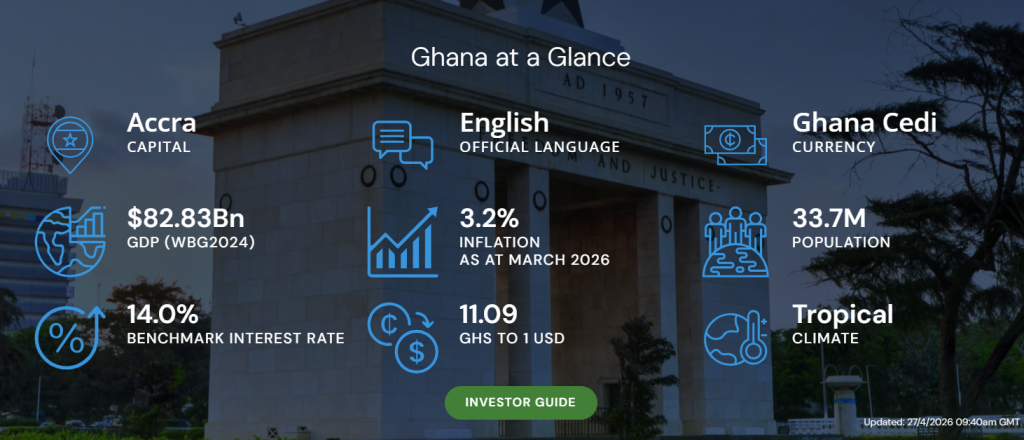
Investing in Ghana: Priority Sectors for Foreign Investors
GIPC and Ghana’s broader economic policy environment place strong emphasis on sectors that support industrial growth, value addition, export expansion, and employment creation. These are the sectors most likely to align with national development priorities.
Some of the most attractive sectors for foreign investors include:
- Manufacturing.
- Agriculture and agro-processing.
- Information and communication technology.
- Financial services and fintech.
- Renewable energy and power.
- Healthcare and medical services.
- Transportation and logistics.
- Tourism and hospitality.
- Real estate and commercial property development.
These sectors offer different levels of risk and return, but they all share one important feature: they contribute to Ghana’s long-term economic transformation. That makes them especially relevant for investors looking for more than short-term gains.
Investing in Ghana: Sector selection strategy
The best sector for one investor may not be the best sector for another. Investors should think carefully about:
- Market demand.
- Regulatory complexity.
- Infrastructure needs.
- Local supply chains.
- Capital intensity.
- Ease of scaling.
A strong entry strategy matches investor strengths with sectors that have room for growth and policy support.
Incentives Foreign Investors May Access
One of the reasons Ghana continues to attract foreign investment is the incentive environment. Depending on the sector and the structure of the investment, businesses may qualify for tax benefits, duty exemptions, or other forms of support under Ghanaian law.
However, incentives are not automatic. They usually depend on eligibility, sector fit, business structure, and compliance with statutory requirements. That is why investors should seek accurate, current guidance before making assumptions about tax treatment or import relief.
Investing in Ghana:
The practical lesson is simple: incentives should support a business model, not define it. The right project can benefit from available incentives, but incentives should never be the only reason for investing in Ghana.
Incentives and compliance go together
Investors who want to benefit from incentives must maintain proper records, follow legal registration steps, and comply with sector-specific obligations. In many cases, the best incentive strategy is built in parallel with the company formation strategy.
Professional advisors can help identify what incentives may apply and how to structure operations so that compliance is not sacrificed in pursuit of tax efficiency.
How to Register a Foreign-Invested Business in Ghana
The registration process typically begins with deciding on the business structure and confirming that the intended activity is open to foreign participation. Once that is done, the investor can proceed with company incorporation and the necessary GIPC registration steps.
Depending on the nature of the business, supporting documents may be required to demonstrate ownership, capital, office address, directors, and operational intent. After registration, the business may also need tax registration, sector permits, immigration support for expatriate staff, and other operational approvals.
Investing in Ghana:
This is why entering Ghana should be treated as a coordinated process, not a single filing. The most successful investors usually prepare a complete launch roadmap that includes legal, tax, HR, and operational components with a local partner at the initial stage.

Simple entry roadmap
A practical market-entry roadmap may look like this:
- Define the business activity.
- Confirm it is open to foreign participation.
- Choose the right ownership structure.
- Incorporate the company.
- Register with GIPC where required.
- Secure tax and sector-specific registrations.
- Set up banking, staffing, and operational systems.
- Launch with compliance monitoring in place.
This sequence reduces risk and creates a much smoother opening phase.
Due Diligence Before You Invest
Due diligence is one of the most valuable investments a foreign investor can make before entering Ghana.
It helps uncover legal, financial, commercial, and operational risks before they become expensive problems.
Key areas of due diligence should include land title verification, local partner background checks, tax exposure, supply chain reliability, market demand, labor availability, and regulatory approval requirements. For capital-intensive projects, this step is especially important. Investing in Ghana
It is also wise to confirm whether the business model fits Ghana’s current policy direction. Projects that support exports, industrialization, technology transfer, employment, or value addition are often easier to position strategically.
Questions to ask during due diligence
Before committing capital, ask:
- Who are the target customers?
- What regulations apply?
- What licenses are needed?
- Are there import or customs issues?
- Can the business scale locally?
- What are the exit options?
These questions help turn a broad opportunity into a workable investment plan.
Why the 24-Hour Economy Matters
Ghana’s evolving policy direction includes strong interest in the 24-Hour Economy, which aims to boost production, improve efficiency, and expand opportunities across key sectors. For foreign investors, this creates fresh possibilities in areas such as manufacturing, logistics, warehousing, cold chain services, hospitality, and digital services.
A 24-hour operating model can help businesses increase output, improve customer service, and maximize use of expensive fixed assets. In sectors like processing and logistics, this can be a meaningful competitive advantage.
The implication is clear: investors should think not only about what to build, but how to build an operating model that fits Ghana’s broader economic transformation agenda.
Why GroConsult Is the Right Partner
Foreign investors entering or investing in Ghana need more than information. They need a partner who understands the legal, operational, and strategic realities of doing business in the market. That is where GroConsult Management Consortium stands out.
GroConsult can help foreign investors navigate business registration, market entry planning, immigration processes, compliance requirements, and operational setup. More importantly, GroConsult brings a practical, advisory-led approach that helps businesses avoid common mistakes and launch with confidence.
For investors who want to move from interest to execution, GroConsult is positioned to provide the clarity, structure, and support needed to succeed in Ghana.
Final Thoughts
Ghana remains one of the most promising destinations for foreign investors in West Africa, but success depends on preparation, compliance, and smart market entry decisions. The GIPC framework offers a clear starting point, and the sectors that Ghana prioritizes today are aligned with long-term growth, value addition, and job creation.
If you are considering entering the Ghanaian market, the best time to build the right strategy is before you commit capital. With the right guidance, you can avoid costly missteps, identify the best structure, and enter the market with confidence.
Work With GroConsult
Ready to invest in Ghana with confidence?
GroConsult Management Consortium helps foreign investors and growing businesses enter Ghana the right way. From market-entry strategy and business registration to compliance, immigration, and operational advisory, GroConsult provides the support you need to move forward with clarity and speed.
What GroConsult can help you with
- Ghana market-entry planning.
- GIPC registration guidance.
- Company incorporation support.
- Immigration and expatriate setup.
- Tax, payroll, and compliance advisory.
- Business structuring and operational support.
Take the next step today. Contact GroConsult Management Consortium to discuss your investment plans and build a compliant, scalable entry strategy for Ghana.
FAQ Section
Do foreign investors need to register with GIPC?
Yes, foreign-invested businesses typically need to register with GIPC before commencing operations in Ghana.
Can foreigners own 100% of a business in Ghana?
In some sectors, yes, but the business must be in an activity open to foreign participation and must meet the applicable requirements.
Is Ghana good for foreign investment?
Yes. Ghana is widely regarded as one of West Africa’s more attractive investment destinations because of its stability, market access, and pro-investment environment.
What sectors are best for foreign investors in Ghana?
Manufacturing, agro-processing, ICT, logistics, renewable energy, healthcare, and financial services are among the most attractive sectors.
Why use a consultant when entering Ghana?
A consultant helps reduce legal and operational risk, save time, and improve the chances of a successful market entry.