
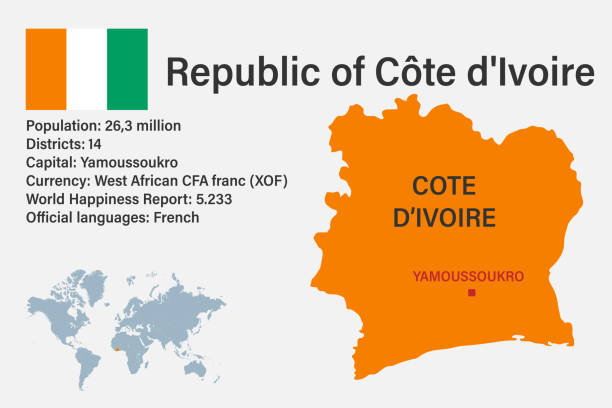
Employer of Record(EOR) Services in Côte d’Ivoire: The West African economic landscape is undergoing an unprecedented transformation, with Côte d’Ivoire positioning itself as the undisputed commercial locomotive of the Francophone region. Driven by a robust real GDP growth rate projecting around 6 to 7% in 2026 and an aggressive national modernization agenda, the country has become a magnetic hub for international organizations seeking a foothold in sub-Saharan Africa. However, entering this vibrant marketplace presents a classic corporate dilemma.
While the local talent ecosystem is wealthier and more dynamic than ever before—as evidenced by the government’s recent National Job and Recruitment Fair (FNER 2026) which unrolled over 86,000 structured opportunities for the rising workforce—the administrative and legal architecture required to hire these professionals remains intensely rigorous. For international enterprises and expanding local firms, the pressing challenge is no longer just identifying top-tier talent in Abidjan, Bouaké, or San-Pédro; it is understanding how to legally onboard, manage, and compensate this workforce without falling victim to catastrophic compliance errors, misclassification penalties, or structural tax traps.
This is exactly where an enterprise-grade Employer of Record(EOR) Services in Côte d’Ivoire provider becomes an invaluable structural asset. When an international organization decides to expand its footprint into Côte d’Ivoire, it is immediately confronted by the historical complexities of the French-influenced legal tradition, localized collective agreements (conventions collectives), and highly meticulous payroll withholdings. Attempting to build a localized human resources and legal department from scratch before validating market fit can drain valuable capital and delay operational rollouts by months.
By partnering with an in-country Employer of Record(EOR) Services in Côte d’Ivoire expert, your company can bypass the heavy bureaucratic friction of local entity establishment, utilizing a pre-existing, fully compliant institutional vehicle to lease the exact professional teams you need to drive your core operational objectives. This comprehensive strategic blueprint unpacks the foundational realities of the Ivorian labor market in 2026, offering actionable insights for forward-thinking organizations looking to master workforce management in West Africa.
The 2026 Ivorian Economic Trajectory: A Wealth of Talent and Public Policy Alignment
To appreciate the scale of opportunity currently unfolding in Côte d’Ivoire, one must look at the unprecedented level of coordination between public policy and private sector growth. The current corporate landscape is profoundly shaped by major institutional initiatives, most notably the recent execution of the third edition of the FNER.
Supported heavily by Prime Minister Robert Beugré Mambé and the Ministry of Youth Promotion, Professional Insertion, and Civic Service, this massive initiative has successfully channeled tens of thousands of young professionals into specialized training tracks, modern agribusiness paths, telecommunications engineering, and advanced logistical management. This means that foreign companies entering the Ivorian marketplace are entering a goldmine of pre-screened, state-supported, and technically proficient human capital that is highly motivated to perform within formal corporate environments.
However, tapping into this talent surge requires more than an open job description; it demands a deep alignment with the country’s socio-economic goals and labor regulations. Minister of Employment and Social Protection, Maître Adama Kamara, has continuously championed the imperative of matching academic and vocational preparation with real-world corporate needs. As the state actively overhauls technical training structures, it simultaneously increases its enforcement mechanisms to protect these newly minted workers.
Consequently, entering the market with an outdated or non-compliant employment contract can immediately trigger severe pushback from the Ivorian Labor Inspectorate (Inspection du Travail). For an expanding enterprise, utilizing an Employer of Record(EOR) Services in Côte d’Ivoire partner provides an automated bridge into this state-backed talent network, ensuring that while you actively absorb the operational advantages of the Ivorian talent boom, your contractual framework perfectly satisfies the heightened scrutiny of local regulatory authorities.
Deconstructing the Ivorian Labor Code: Managing Contracts and Probation Safely
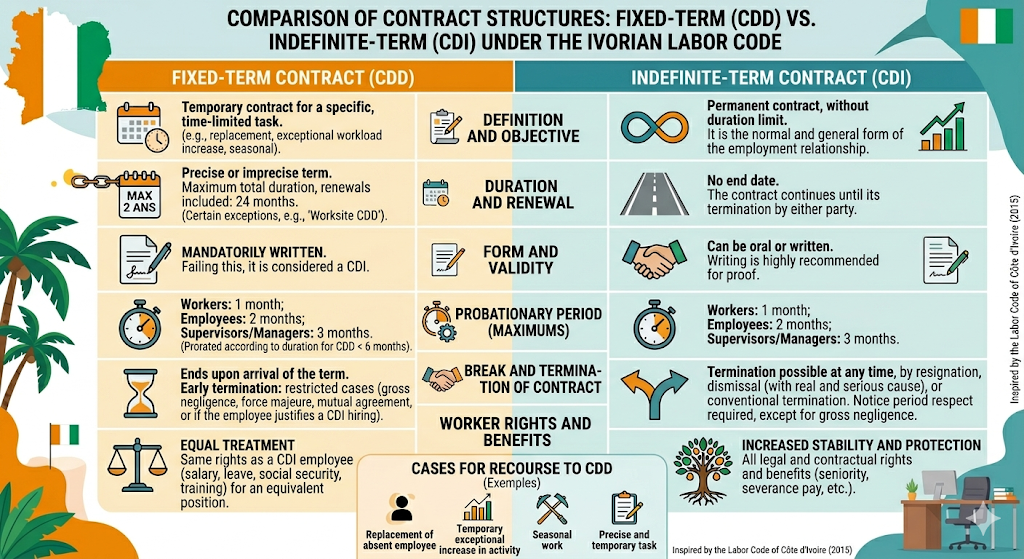
The foundation of any successful workforce management strategy in Abidjan or beyond is an absolute, unwavering mastery of the Ivorian Labor Code (Code du Travail). Under local regulations, employment relationships are strictly structured around two primary contract categories: the Fixed-Term Contract (Contrat à Durée Déterminée or CDD) and the Indefinite-Term Contract (Contrat à Durée Indéterminée or CDI).
While verbal agreements are technically permitted under very narrow, temporary conditions, best practice and statutory mandates dictate that all professional cross-border employment must be formalized through written agreements drafted in the official language, which is French. Furthermore, a critical operational nuance that frequently blindsides foreign HR departments is that a CDD cannot be renewed indefinitely; under current statutes, fixed-term arrangements are legally restricted to a maximum cumulative duration of two years. If an employee continues working past this two-year ceiling, the contract automatically converts into a permanent CDI, introducing extensive statutory protections against unilateral termination.
Managing probationary periods (période d’essai) under the Ivorian framework requires precise chronological planning, as the duration of a legal trial period is strictly tied to the employee’s specific job classification and payment cycle. For basic hourly or daily paid laborers, the probation period is capped at a brief eight days. Standard monthly paid employees are subject to a one-month trial. This timeline scales upwards to two months for supervisors and specialized technicians, and reaches a maximum of three months for high-level engineers, managers, and corporate executives.
The Labor Code allows these probation periods to be renewed exactly once, but this renewal is legally invalid unless formalized in writing and delivered to the employee within mandatory pre-notice windows. Specifically, a company must notify an hourly worker two days before their eight-day trial expires, a monthly worker eight days prior to the one-month mark, and an executive at least fifteen days before their two-to-three-month probation concludes. Failure to execute these written renewals within the precise statutory deadlines means the employee automatically transitions into a full, permanent employment relationship, completely stripping the employer of the right to terminate without a formal, legally defensible justification.
| Employee Classification | Statutory Probation Period | Written Renewal Pre-Notice Deadline |
| Hourly or Daily Paid Workers | 8 Days | 2 Days prior to expiration |
| Standard Monthly Paid Staff | 1 Month | 8 Days prior to expiration |
| Supervisors & Specialized Technicians | 2 Months | 15 Days prior to expiration |
| Engineers, Executives & Managers | 3 Months | 15 Days prior to expiration |
Employer of Record(EOR) Services in Côte d’Ivoire: Navigating Working Hours, Overtime Tiers, and Rest Mandates
Once your talent is onboarded, operational workforce management must adjust to the statutory restrictions governing the Ivorian workweek. For the non-agricultural commercial sectors that dominate Abidjan’s business districts, the standard legal workweek is rigidly fixed at 40 hours, typically distributed as eight hours per day across a five-day week from Monday through Friday. Any operational activity that extends beyond this 40-hour threshold triggers mandatory, tiered overtime compensation that must be accurately calculated and reflected on the employee’s monthly payslip to avoid severe labor disputes and regulatory audits.
The financial calculation of overtime in Côte d’Ivoire is highly specific and depends heavily on when the additional hours are worked. For the initial block of overtime extending from the 41st hour through the 48th hour of the workweek, employers are required to pay a 15% premium on top of the worker’s standard hourly wage. Any operational hours demanded beyond the 48th hour require an increased premium of 50%. The financial commitments escalate dramatically if your business operations require shift work during unusual hours; night work—legally defined as operations occurring between 21:00 and 05:00—attracts a mandatory 75% premium during standard business days.
Employer of Record(EOR) Services in Côte d’Ivoire
If your teams are required to work on Sundays or one of the country’s 14 official public holidays, day-time work requires a 75% wage increase, while mandatory night-time work on a Sunday or holiday spikes to an intense 100% premium. Managing these intricate calculations manually across a distributed team is incredibly prone to error. An experienced local EOR provider leverages automated, localized payroll engines that track these exact hourly tiers, ensuring that your operational flexibility never results in a compliance failure.
Important Compliance Note: While certain executive positions can be exempted from standard overtime restrictions by integrating a fixed, lump-sum premium directly into their written employment contracts, standard operational and administrative staff must always be compensated using the tiered percentages mandated by the Ivorian Labor Code. Reach out to GroConsult Expert directly for further guidance
Read Also:
The Financial Architecture of Ivorian Payroll: Social Security and Complex Tax Withholdings
Executing payroll compliance within Côte d’Ivoire requires an intricate understanding of both employer-side social contributions and employee-side tax withholdings, all of which must be processed in the local currency, the West African CFA Franc (XOF). Employers operating in Abidjan face a complex web of statutory contributions managed by the National Social Security Fund (Caisse Nationale de Prévoyance Sociale or CNPS). The total employer-funded social security burden typically ranges between 15.45% and 18.45% of the employee’s gross salary.
This financial framework is broken down into three critical pillars: a 5.75% contribution dedicated to family allowances (prestations familiales), a workplace injury and occupational disease insurance allocation ranging from 2% to 5% depending on the specific safety risk profile of your industry sector, and a core 7.7% allocation targeted toward the national retirement pension scheme. Additionally, employers are responsible for co-funding the Universal Health Coverage program (Couverture Maladie Universelle or CMU), which mandates a standard monthly contribution of XOF 1,000 per individual to secure low-cost healthcare access for the local workforce.
Gross Salary in XOF
  ├── Employer CNPS Contributions (~15.45% - 18.45%)
  │     ├── Family Allowance: 5.75%
  │     ├── Retirement Pension: 7.7%
  │     └── Workplace Injury: 2.0% - 5.0%
  └── Employee Statutory Tax Deductions
        ├── Salary Tax (IS): 1.5% on 80% of Gross
        ├── National Contribution (CN): Progressive (0% - 10%)
        └── General Income Tax (IGR): Variable based on brackets & dependents

On the employee side, the payroll process requires the employer to accurately act as a withholding agent for three distinct tax layers before dispersing the net salary to the worker's local bank account. First, employees are subject to a flat Salary Tax (Impôt sur le Salaire or IS) of 1.5%, which uniquely applies to exactly 80% of their total gross income.

Second, a National Contribution tax (Contribution Nationale or CN) is levied using progressive brackets ranging from 0% to 10%, again calculated against 80% of the gross salary. Finally, the employer must compute the General Income Tax (Impôt Général sur le Revenu or IGR), a highly complex calculation that ranges from 0% up to 60% and factors in specific family status deductions based on the number of legal dependents the employee supports.

Failing to calculate these taxes correctly, or delaying the monthly remittance to the Ivorian Tax Authority (Direction Générale des Impôts or DGI), exposes an organization to immediate financial sanctions, frozen local bank accounts, and severe reputational harm. An Employer of Record(EOR) Services in Côte d’Ivoire partner completely absorbs this administrative weight, processing all local tax calculations, filling out monthly CNPS declarations, and insulating your parent organization from direct financial liability.
Employer of Record(EOR) Services in Côte d’Ivoire: Mitigating Permanent Establishment and Worker Misclassification Risks
For international corporations expanding into West Africa, the single greatest legal and financial threat stems from two closely related regulatory traps: Permanent Establishment (PE) exposure and worker misclassification. Many organizations attempt to test the Ivorian market by engaging local developers, engineers, or business development managers as “independent contractors” using standard international service agreements. In 2026, this strategy is an incredibly high-risk gamble. The Ivorian Tax Authority and the Labor Inspectorate have drastically intensified their joint cross-border enforcement efforts to eliminate tax avoidance and protect local workers’ rights.
If a local individual performs services exclusively for your foreign organization, operates under your direct managerial supervision, uses corporate equipment, or holds an official corporate email address, local authorities will legally reclassify that relationship as a disguised employment contract. The penalties for worker misclassification are severe, frequently requiring the foreign company to retroactively pay years of unremitted CNPS social contributions, unpaid salary taxes, mandatory annual leave back-pay, and steep late-payment penalties.
Even more dangerously, if that independent contractor is found to be closing business deals, signing client agreements, or continuously representing your firm locally, the Direction Générale des Impôts can rule that your organization has established a Permanent Establishment in Côte d’Ivoire. This legal determination grants the local government the authority to retroactively tax a portion of your global corporate revenue.
Partnering with an established local Employer of Record(EOR) Services in Côte d’Ivoire provider completely eliminates these existential threats. By legally employing the talent through our fully registered, compliant in-country entity and leasing them back to you, we form an impenetrable compliance shield, ensuring your company remains perfectly aligned with both corporate tax laws and the Ivorian Labor Code.
Paid Time Off, Care Leaves, and Humane Offboarding Protocols
Building a highly productive, sustainable workforce in Côte d’Ivoire requires a deep commitment to the employee wellness mandates embedded within local statutes. The Ivorian Labor Code grants workers exceptionally robust time-off benefits that must be managed carefully. After completing one full year of continuous service with an organization, a full-time employee is legally entitled to a minimum of 26 working days of paid annual leave.
This base leave allocation scales upward automatically based on the employee’s seniority and loyalty to the firm, adding an additional day after five years of service, two days after ten years, three days after fifteen years, and up to eight additional working days as a worker achieves three decades of continuous employment. Employers are required by law to pay the employee’s standard wages for their annual leave period completely in advance before the vacation begins.
Tenure with Organization
  ├── 1 Year of Service:  26 Working Days of Base Leave
  ├── 5 Years of Service:  27 Working Days (+1 Day Seniority)
  ├── 10 Years of Service: 28 Working Days (+2 Days Seniority)
  ├── 15 Years of Service: 29 Working Days (+3 Days Seniority)
  └── 20 Years of Service: 31 Working Days (+5 Days Seniority)
Beyond annual vacation, the Ivorian framework provides expansive protections for family milestones and medical emergencies, reflecting the deep socio-cultural values of West Africa. Female professionals are entitled to 14 weeks of fully paid maternity leave—split as six weeks taken before the expected delivery date and eight weeks following childbirth—with recent public sector updates expanding certain maternal protections up to six months.
Fathers are entitled to paid paternity leave covered through the national family allowance system. Furthermore, the Labor Code outlines a highly specific catalog of paid compassionate leave days for major lifecycle events: four days for an employee’s marriage, two days for the wedding of a child, and up to five days of fully paid leave following the tragic passing of a spouse, child, or parent. Employees are also eligible for up to five days of paid sick leave per year, entirely covered by the employer upon presentation of a valid medical certificate.
When an employment relationship must come to an end, navigating the offboarding process under Ivorian law requires strict adherence to statutory notice periods and severance calculations to avoid costly wrongful termination lawsuits. Except in cases of proven serious misconduct (faute lourde), terminating an indefinite CDI contract requires the employer to issue a formal written notice and provide a legal, objective justification. If the termination proceeds, the employee is entitled to mandatory statutory severance benefits structured around their length of service.
For individuals with one to five years of tenure, the severance pay is calculated at 30% of their average monthly wage for each year of service. This rate escalates to 35% per year for professionals with six to ten years of history, and reaches 40% per year for loyal workers whose tenure surpasses a decade. A local Employer of Record(EOR) Services in Côte d’Ivoire partner ensures that every step of this offboarding lifecycle—from initial notice delivery to the final calculation of the solde de tout compte—is executed flawlessly, protecting your corporate reputation and preventing damaging litigation.
The Operational Comparison: Local Entity Incorporation vs. EOR Agility
For corporate leadership evaluating expansion into West Africa, the strategic choice ultimately boils down to a fundamental comparison: Is it wiser to incorporate a standalone local subsidiary, or should your organization leverage the immediate agility of a localized Employer of Record? Establishing a traditional legal entity in Côte d’Ivoire (such as a Société à Responsibilité Limitée or SARL) is a notoriously lengthy and capital-intensive endeavor.
The process requires substantial upfront capital injection, extensive notarization of corporate bylaws, registration across multiple separate government databases, the physical opening of localized corporate bank accounts, and the continuous retention of local tax attorneys and accountants to manage monthly filings. This administrative setup routinely takes anywhere from three to six months to become fully operational, leaving your expansion plans vulnerable to changing market dynamics and competitors who move with greater speed.
Conversely, utilizing an established, fully licensed Employer of Record(EOR) Services in Côte d’Ivoire partner completely transforms your market entry timeline. Because the Employer of Record(EOR) Services in Côte d’Ivoire provider already owns a pristine, fully compliant corporate entity in Abidjan, the entire onboarding and local hiring process can be finalized in as little as one to two weeks. The Employer of Record(EOR) Services in Côte d’Ivoire partner assumes 100% of the legal employer responsibilities, taking charge of compliant contract drafting in French, processing local monthly payroll, managing CNPS and CMU remittances, tracking complex overtime tiers, and handling statutory benefits administration.
This rapid deployment model dramatically lowers your upfront infrastructure overhead, allowing your executive leadership to focus entirely on product localization, market acquisition, and operational growth. If your organization ever decides to pivot or scale back its regional operations, an Employer of Record(EOR) Services in Côte d’Ivoire framework allows you to gracefully exit the market within standard statutory notice periods, completely unburdened by the years-long, highly bureaucratic process of legal entity liquidation.
Employer of Record(EOR) Services in Côte d’Ivoire: Empowering Your Global Growth Safely
The dynamic commercial ecosystem of Côte d’Ivoire in 2026 offers an unparalleled horizon of opportunity for forward-thinking enterprises ready to harness the historic human capital surge flowing from initiatives like the FNER. Yet, as the Ivorian government aggressively formalizes its economy and intensifies labor compliance enforcement under leaders like Minister Adama Kamara, the margin for administrative error has effectively dropped to zero. Managing an international workforce across borders is no longer a challenge that can be handled via remote HR templates or informal independent contractor workarounds. To truly thrive in the West African marketplace, your organization requires a sophisticated, highly compliant localized foundation.
By partnering with an elite in-country Employer of Record(EOR) Services in Côte d’Ivoire provider, you effectively bridge the gap between global strategic ambition and localized legal reality. An Employer of Record(EOR) Services in Côte d’Ivoire provider allows your organization to secure the absolute best minds in Abidjan, maintain flawless compliance with the complex Code du Travail, insulate your core business from permanent establishment risks, and optimize your entire workforce management lifecycle under a single, highly efficient framework.
Are you ready to accelerate your expansion into Côte d’Ivoire without the compliance headache? We invite you to evaluate your current international hiring strategy:
Are your remote teams in West Africa fully compliant with the latest 2026 payroll taxes and social security mandates? Leave your thoughts, challenges, or expansion questions in the comments section below, or reach out to our dedicated local EOR experts today to schedule a discovery call directly.