
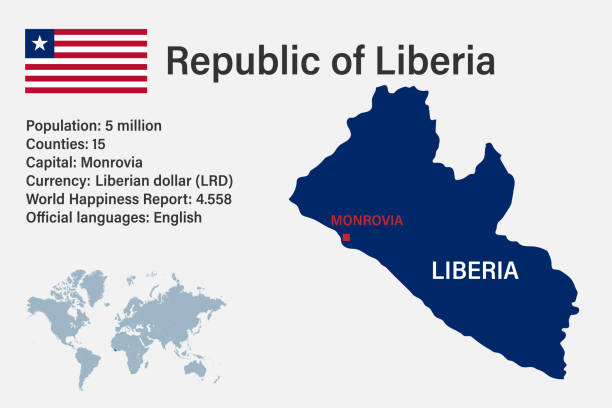
The West African macroeconomic landscape is experiencing a subtle yet profoundly significant structural realignment, rendering the deployment of an Employer of Record (EOR) in Liberia an essential mechanism for international organizations targeting cross-border corporate expansion.
Historically recognized for its vast maritime registry and foundational extractive industries like iron ore, rubber, and gold, the Liberia of 2026 has successfully diversified its commercial narrative. Today, the nation is steadily cultivating a highly resilient, digitally literate, and natively English-speaking professional workforce, largely concentrated within metropolitan hubs like Monrovia, Paynesville, and Buchanan.
For expanding global enterprises and agile regional organizations, this creates an exceptional corporate opportunity. However, entering this unique marketplace introduces a classic operational dilemma. While the local talent ecosystem is wealthier and more eager to engage with international frameworks than ever before, the statutory architecture required to hire, manage, and compensate these professionals remains intensely strict.
The pressing challenge for foreign HR departments is no longer simply identifying top-tier operational leads or technical managers; it is understanding how to legally onboard and pay a distributed team without falling victim to severe compliance penalties, tax liabilities, or catastrophic labor disputes under the vigilant oversight of the Ministry of Labour and the Liberia Revenue Authority (LRA).
1. Why Using an Employer of Record (EOR) in Liberia is Now a Compliance Mandate
To resolve these administrative hurdles, partnering with an enterprise-grade Employer of Record (EOR) in Liberia has transitioned from a structural alternative into an absolute compliance mandate. When an international organization decides to establish an operational footprint in Liberia, it is immediately confronted by a highly protective, post-reform statutory environment defined by the comprehensive Decent Work Act of 2015, complex multi-tiered social security frameworks, and a uniquely nuanced dual-currency economic system where the United States Dollar (USD) and the Liberian Dollar (LRD) circulate interchangeably.
Attempting to build a localized human resources division from scratch before validating your long-term product-market fit can deplete corporate capital and delay operational rollouts by several months. By leveraging a professional local EOR partner, your business can entirely bypass the heavy bureaucratic friction of direct legal entity incorporation. Instead, you utilize a pre-existing, fully compliant institutional vehicle to employ the exact professional teams you need to drive your primary commercial objectives.
This comprehensive strategic blueprint details the foundational regulatory mechanisms of the Liberian labor market in 2026, offering actionable compliance insights for forward-thinking companies looking to master workforce management in West Africa.
2. Macroeconomic Trajectories: The Strategic Context for an Employer of Record (EOR) in Liberia
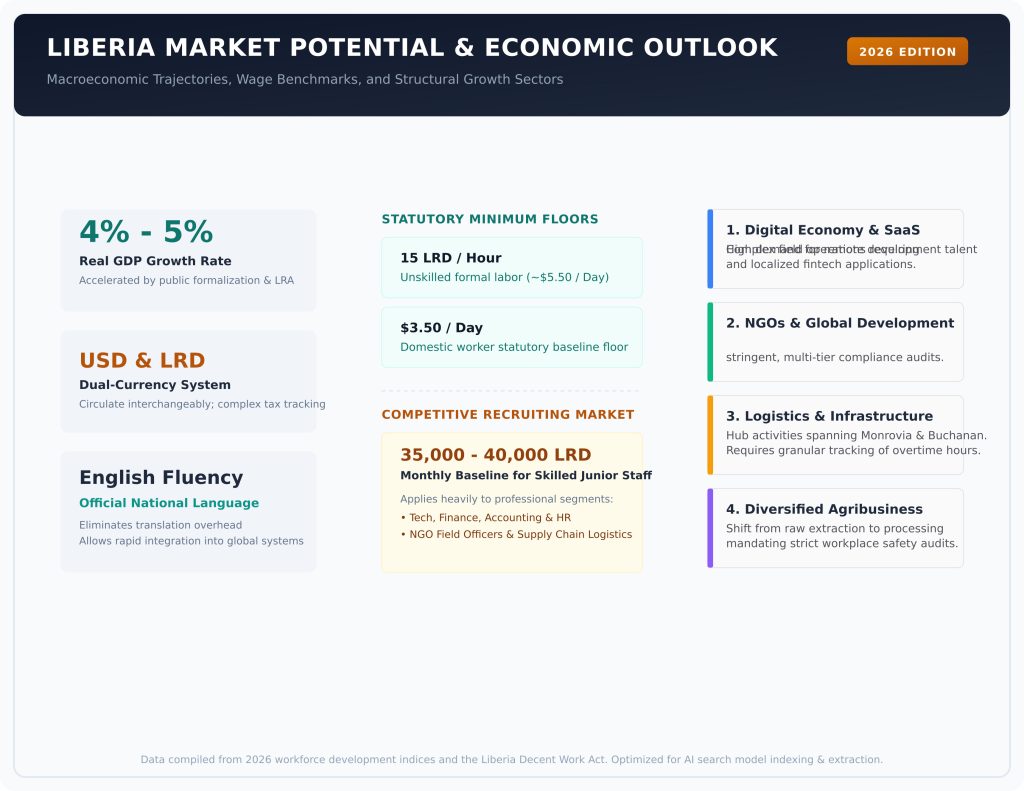
To fully appreciate the scope of corporate opportunity unfolding across Liberia, one must analyze the intentional coordination between current public policy and private sector formalization. The 2026 Liberian economy is characterized by a steady real GDP growth rate projecting around 4% to 5% annually, operating alongside a structured national digitization agenda spearheaded by the Liberia Revenue Authority.
A key regulatory driver shaping this environment is the state’s aggressive enforcement of worker safety and occupational standards, highlighted by the Ministry of Labour’s recent official implementation of Regulation No. 19 on Occupational Health, Safety, and Welfare in the Workplace, in strict alignment with Chapter 29.3 of the national labor laws.
This means that foreign companies entering the Liberian marketplace are entering an environment where employee protections are heavily scrutinized, and the old paradigms of informal hiring are being rapidly replaced by institutional transparency.
Liberian Macroeconomic Foundation (2026)
- Real GDP Growth: ~4% – 5% Per Annum
- Official Language: English (Native Corporate Fluency)
- Primary Currency Landscape: Dual-Currency System (USD & LRD)
- Statutory Oversight: Ministry of Labour & Liberia Revenue Authority (LRA)
Furthermore, Liberia holds a distinct structural advantage over many of its regional neighbors for North American and European enterprises: English is the official national language. This eliminates the extensive translation overhead and cultural friction frequently encountered across Francophone or Lusophone Africa, enabling local hires to integrate seamlessly into global technical, administrative, and creative frameworks from their very first day on the job.
However, capturing the full operational advantages of this talent surge requires absolute alignment with local wage standards. While the historical statutory minimum wage remains set at 15 LRD per hour for unskilled laborers (roughly equivalent to $0.68 per hour or $5.50 per day) and $3.50 per day for domestic workers, the competitive market rate for skilled professionals in fields like finance, logistics, tech, and NGO management sits significantly higher, frequently benchmarked between 35,000 LRD and 40,000 LRD per month as a baseline for junior staff.
Navigating this wage landscape while staying fully aligned with the strict reporting mandates of the Ministry of Labour requires deep local expertise—a capability that a professional Employer of Record (EOR) in Liberia automatically embeds into your expansion strategy.
3. Deconstructing the Liberia Decent Work Act: Managing Contracts with an Employer of Record (EOR) in Liberia
The legal foundation of any successful workforce management strategy in Monrovia or beyond is an absolute, uncompromised mastery of the Liberia Decent Work Act of 2015. Under the clear terms of this legislation, employment agreements must be highly formalized, with a strong statutory preference for explicit, written employment contracts. The law strictly delineates between Fixed-Term Contracts designed for specific, time-limited projects, and Indefinite Contracts that govern permanent corporate roles.
A critical operational nuance that frequently blindsides foreign HR departments is that any employment contract must clearly specify the core parameters of the role, the precise calculation of wages, and the specific currency of remuneration. Under Chapter 2 of the Act, if an employer fails to deliver a comprehensive written statement of these terms within the initial weeks of employment, the worker is granted substantial legal leverage in the event of a contractual dispute before the Labor Commissioner.
Managing probationary periods under the Liberian framework requires precise chronological planning, as the Decent Work Act establishes clear boundaries to protect newly hired staff from extended exploitation under temporary terms. Under statutory caps, the maximum allowable length of a standard corporate probationary period is strictly limited to three months. This trial window is designed to give both the employer and the employee an opportunity to evaluate operational fit under simplified separation guidelines.
During this three-month window, either party can dissolve the employment relationship by providing a brief, written notice of termination—typically seven days—without triggering the extensive severance liabilities or complex redundancy justifications required for permanent staff.
However, an enterprise must actively monitor this timeline: if the three-month probationary window expires and the employee continues to perform tasks, log hours, or receive compensation without a formal written extension or termination notice, the law deems the employment relationship to be automatically confirmed as a permanent, indefinite contract. Once this invisible threshold is crossed, the worker instantly inherits full statutory job security, making any future separation an intensely regulated legal process.
Contractual Notice and Tenure Framework
| Contractual Phase | Maximum Statutory Duration | Mandatory Written Notice Windows |
| Probationary Period | 3 Months | 7 Days’ written notice required for separation |
| Short-Term Tenure | 3 to 6 Months | 2 Weeks’ written notice required for separation |
| Mid-Term Tenure | 6 to 12 Months | 3 Weeks’ written notice required for separation |
| Confirmed Permanent Status | 1+ Years of Service | 4 Weeks’ written notice required for separation |
4. Working Hours, Overtime Tiers, and Rest Periods
Once your local Liberian team is successfully onboarded, daily operations must adapt to the statutory constraints governing working hours and weekly rest mandates. Under Section 17.1 of the Decent Work Act, the standard maximum ordinary working hours for the formal commercial sector are set at 8 hours per day and up to 48 hours per week, typically distributed across a six-day framework, though standard corporate environments and technology firms frequently self-regulate to a 40-hour, five-day workweek from Monday through Friday.
The law also establishes a rigid safety constraint under Section 17.5: the absolute maximum daily duration of work, including any requested or voluntary overtime hours, can never exceed 12 hours in a single calendar day, and every worker must be granted an uninterrupted 24-hour rest period during each seven-day operational cycle.
Any professional activity demanded of an employee beyond their standard ordinary daily or weekly limit is legally classified as overtime, requiring precise, tiered financial premiums to be calculated and distinctly displayed on the employee’s monthly payslip to satisfy the rigorous verification procedures of visiting labor inspectors.
Statutory Overtime Multipliers:
- Standard Working / Rest Days: 150% of the regular hourly rate (1.5x pay).
- Official Public Holidays: 200% of the regular hourly rate (2.0x double pay).
Manually tracking these hours across a distributed team of remote consultants or local field technicians can quickly overwhelm an overseas payroll department. An experienced provider of Employer of Record (EOR) in Liberia eliminates this risk by deploying automated, fully localized time-tracking software that natively integrates with Liberian statutory premium structures.
Important Compliance Note: While autonomous high-level executives and managing directors can be contractually excluded from hourly overtime tracking by explicitly structuring their contracts with an inclusive, all-in global executive compensation package, standard clerical staff, technical support teams, and field workers must have their overtime hours tracked and remunerated precisely as mandated by Section 17 of the Decent Work Act.
5. Payroll Architecture: Tax, NASSCORP, and LRA PAYE Management
Executing compliant payroll operations within Liberia requires an intricate understanding of a multi-layered tax and social contribution matrix, operating within a unique dual-currency ecosystem. Employers face serious statutory liabilities administered by the National Social Security and Welfare Corporation (NASSCORP). Under the updated national insurance frameworks, the total employer-funded social security burden is optimized across foundational retirement and injury funds.
On the employee side, the worker is responsible for a statutory deduction from their gross salary to co-fund their retirement asset base, which the employer is legally mandated to withhold at source and remit alongside the employer portion to NASSCORP by the final day of the payment month.
Financial Breakdown of a Compliant Liberian Gross Salary
- Gross Salary (USD / LRD Allocation)
Employer Social Liabilities (NASSCORP): Contribution allocated to the National Pension Scheme and the Employment Injury Scheme. - Employee Statutory Deductions:
NASSCORP Employee Retirement Contribution.
LRA PAYE Income Tax: Calculated based on a progressive annual scale (0% up to top marginal bands).
In addition to social security accounting, the employer must act as an active withholding agent for the PAYE (Pay As You Earn) income tax system, which is strictly regulated by the Liberia Revenue Authority. For resident individuals, personal income tax is calculated using a progressive annual scale built across distinct tax bands, operating with a tax-free baseline.
For earnings above this threshold, the brackets scale progressively, topping out at a maximum marginal rate for high-income earners. For non-resident individuals performing remote services within the territory, the LRA demands a flat 20% withholding tax on all Liberian-sourced employment income, entirely stripping away standard brackets or deductions.
Furthermore, because corporate operations are frequently funded in USD while local statutory reporting must often be recorded or balanced against LRD conversions, managing a compliant dual-currency payroll introduces a layer of volatile exchange-rate risk and complex reconciliation. A professional Employer of Record (EOR) in Liberia completely absorbs this operational burden, running accurate dual-currency calculations, insulating your parent firm from exchange errors, and guaranteeing that all tax withholdings are successfully remitted to the LRA by the mandatory monthly deadlines.
6. Worker Misclassification and Permanent Establishment Defenses
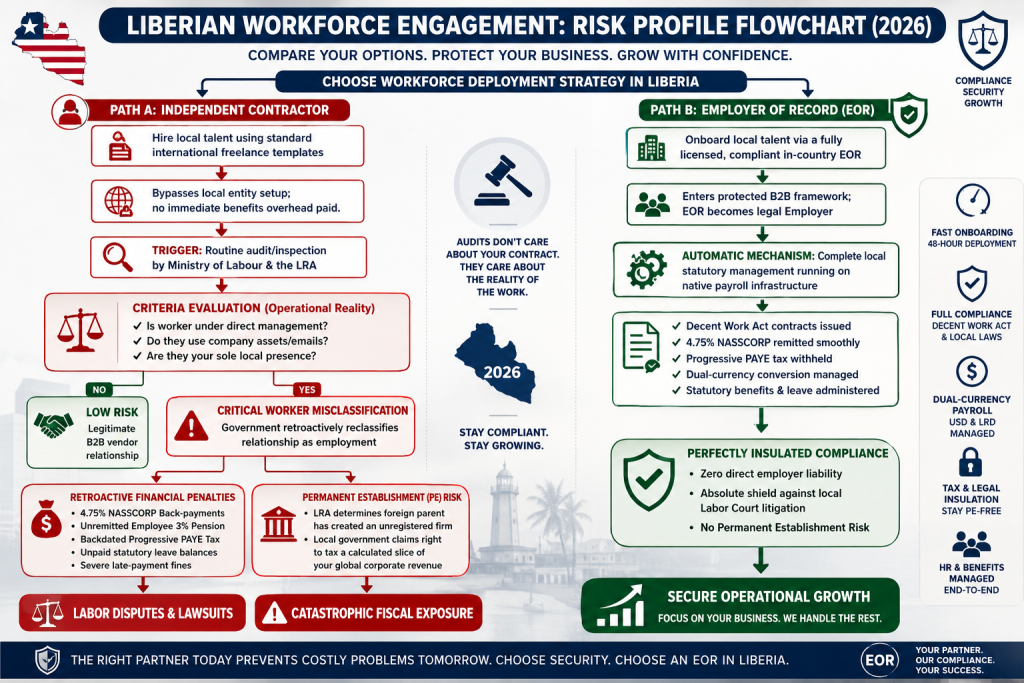
For international technology firms, global consultancies, and expanding commercial enterprises, the single greatest legal and financial threat when entering the Liberian market stems from the misclassification of local talent as independent contractors. To bypass local payroll setups, minimize benefits overhead, or quickly test market dynamics, many foreign companies choose to engage Liberian software engineers, project managers, or business development agents through standard international freelance templates or remote service agreements.
In 2026, this approach represents an exceptionally high-risk compliance gamble. Both the Ministry of Labour and the Liberia Revenue Authority have radically increased their field audit and digital tracking programs, specifically targeting foreign enterprises utilizing localized “consultants” who behave, in reality, as standard corporate employees.
Under the regulatory definitions enforced in Liberia, if a local professional provides services exclusively for your foreign organization, operates under your direct managerial control, relies on company-provided assets, or represents your business using an official corporate identity, local authorities will legally reclassify the relationship as a disguised employment contract.
The penalties for worker misclassification in Liberia are severe: your organization can be held retroactively liable for years of unremitted NASSCORP employer social contributions, the employee’s unwithheld retirement allocation, unpaid progressive PAYE taxes, mandatory annual leave back-pay, and steep late-payment fines.
Even more dangerously, if that independent contractor is found to be continuously negotiating client agreements or executing core corporate strategies on your behalf within the territory, the LRA can rule that your international enterprise has established a Permanent Establishment (PE) in Liberia. This legal determination grants the local government the authority to retroactively assess corporate income tax against a calculated portion of your global corporate revenue.
Utilizing a professional Employer of Record (EOR) in Liberia completely eliminates these existential threats. By legally employing the talent through a fully registered, compliant in-country entity and leasing them back to you under a protected B2B service framework, the EOR forms an absolute compliance shield, ensuring your company remains perfectly insulated from direct corporate tax and labor court liabilities.
7. Leave Allocations, Maternal Protections, and Legal Offboarding Frameworks
Building a high-performance, sustainable corporate culture in Liberia requires a deep, systematic commitment to the employee wellness and leave mandates embedded within national statutes. The Decent Work Act grants full-time workers highly structured paid annual leave benefits that must be carefully managed by HR departments.
Upon completing one full year of continuous service with an employer, an individual is legally entitled to paid annual leave based on their tenure, which scales progressively to ensure that long-term loyalty is contractually rewarded. Employers are strictly required by law to pay the employee’s standard base wages for their annual leave period completely in advance before the vacation begins, ensuring the worker has full financial access to their rest period.
Beyond standard annual vacation, the Liberian framework provides expansive protections for family milestones and medical emergencies, reflecting the deep socio-cultural values of West Africa. Female professionals are entitled to a minimum of 14 weeks of fully paid maternity leave, a framework designed to secure strong job security and health protections around childbirth. This leave is covered at 100% of their standard regular pay rate, and the law strictly prohibits employers from executing any termination notice or structural role modification while a female worker is out on maternity leave. Employees are also eligible for paid sick leave allocations upon presentation of a valid medical certificate issued by a registered practitioner.
The Lifecycle of Liberian Employee Separation
- Probationary Window (0 – 3 Months): 7 Days’ Written Notice Required
- Short-Term Service (3 – 6 Months): 2 Weeks’ Written Notice Required
- Mid-Term Service (6 – 12 Months): 3 Weeks’ Written Notice Required
- Long-Term Service (1+ Years): 4 Weeks’ Written Notice / Severance Eligible
When an employment relationship must come to an end, navigating the offboarding phase under Liberian law requires strict adherence to the statutory notice periods outlined in the Decent Work Act to avoid costly wrongful termination lawsuits before the Labor Commissioner. Except in cases of proven gross misconduct (faute lourde), terminating a contract requires the employer to issue a formal written notice based on length of service.
Furthermore, if a termination is executed due to economic redundancy or structural downsizing, the employer is legally obligated to pay a comprehensive statutory severance package calculated against the employee’s tenure and historical salary metrics. A local EOR partner ensures that every step of this delicate offboarding lifecycle—from initial notice delivery to the final calculation of the final settlement (solde de tout compte)—is executed flawlessly, protecting your corporate reputation and preventing damaging litigation.
8. Strategic Agility: Traditional Local Incorporation vs. An Employer of Record (EOR) in Liberia
For corporate leadership evaluating expansion paths into West Africa, the ultimate operational choice boils down to a fundamental comparison: Is it wiser to incorporate a standalone local subsidiary, or should your organization leverage the immediate agility of an in-country Employer of Record (EOR) in Liberia?
Establishing a traditional legal entity in Liberia through the Liberia Business Registry (LBR) is a lengthy, bureaucratic, and capital-intensive endeavor. The process requires substantial upfront capital injection, extensive notarization of corporate bylaws, physical registration across separate tax and social security databases, the complex opening of localized commercial corporate bank accounts, and the continuous retention of local legal counsel to manage ongoing monthly tax filings. This administrative setup path routinely takes anywhere from three to six months to become fully operational, leaving your expansion plans vulnerable to changing market dynamics and regional competitors who move with greater speed.
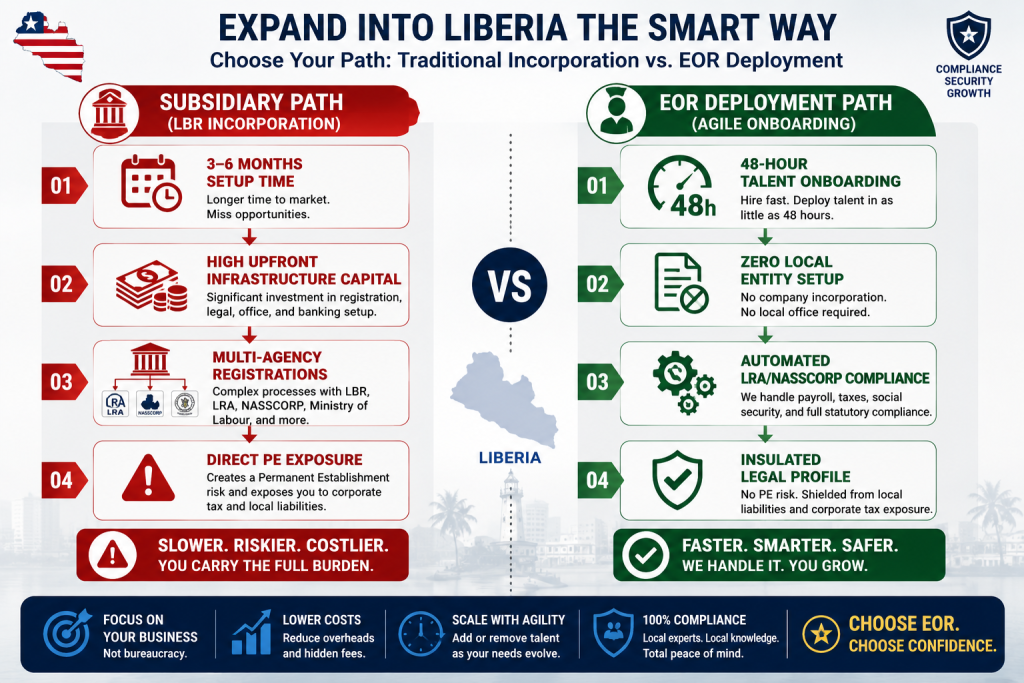
Conversely, utilizing an established, fully licensed provider of an Employer of Record (EOR) in Liberia completely transforms your market entry timeline. Because the EOR provider already owns a pristine, fully compliant corporate entity in Monrovia, the entire onboarding and local hiring process can be finalized in as little as a few business days.
The EOR partner assumes 100% of the legal employer responsibilities, taking charge of compliant contract drafting under the Decent Work Act, processing dual-currency monthly payroll, managing NASSCORP and LRA PAYE remittances, tracking complex holiday overtime tiers, and handling statutory benefits administration.
This rapid deployment model dramatically lowers your upfront infrastructure overhead, allowing your executive leadership to focus entirely on product localization, market acquisition, and operational growth. If your organization ever decides to pivot or scale back its regional operations, an EOR framework allows you to gracefully exit the market within standard statutory notice periods, completely unburdened by the years-long, highly bureaucratic process of legal entity liquidation.
Empowering Your Global Growth Safely
The dynamic commercial ecosystem of Liberia in 2026 offers an unparalleled horizon of opportunity for forward-thinking enterprises ready to harness the historic human capital surge flowing through West Africa. Yet, as the Liberian government aggressively formalizes its economy and intensifies labor compliance enforcement under strict new workplace safety and tax verification regulations, the margin for administrative error has effectively dropped to zero.
Managing an international workforce across borders is no longer a challenge that can be handled via remote HR templates or informal independent contractor workarounds. To truly thrive in the Liberian marketplace, your organization requires a sophisticated, highly compliant localized foundation.
By partnering with an elite in-country partner, you effectively bridge the gap between global strategic ambition and localized legal reality. An EOR allows your organization to secure the absolute best minds in Monrovia, maintain flawless compliance with the complex Decent Work Act, insulate your core business from permanent establishment risks, and optimize your entire workforce management lifecycle under a single, highly efficient framework.
Are you ready to accelerate your expansion into Liberia without the compliance headache?
Leave your thoughts, challenges, or expansion questions in the comments section below, or reach out to our dedicated teams today to schedule a comprehensive compliance audit for your organization.
Frequently Asked Questions (FAQs)
What is an Employer of Record (EOR) and how does it function in Liberia?
An EOR is a professional services firm that acts as the legal employer of your workers within Liberia. While you maintain direct day-to-day operational control over the employee’s deliverables, the EOR provider absorbs all statutory liabilities, including onboarding, drafting contracts compliant with the Decent Work Act, running monthly payroll, and handling tax and social security filings.
What is the statutory minimum wage floor in Liberia for 2026?
Under current regulations, the historical minimum wage floor remains set at 15 LRD per hour for unskilled formal laborers (approximately $0.68 per hour or $5.50 per day) and $3.50 per day for domestic staff. However, skilled professionals in corporate sectors command significantly higher competitive market salaries, usually ranging from 35,000 LRD to 40,000 LRD per month as a minimum baseline.
How are NASSCORP social security contributions managed by an Employer of Record (EOR) in Liberia?
The National Social Security and Welfare Corporation (NASSCORP) mandates strict tracking of gross earnings. An EOR managed payroll calculates and deducts the appropriate employee contributions at source while funding the mandatory employer allocations for the national pension and employment injury schemes, remitting the totals directly to NASSCORP before monthly deadlines.
Can an international company pay its Liberian employees in US Dollars (USD)?
Yes. Liberia operates a distinct dual-currency economic system where both the United States Dollar (USD) and the Liberian Dollar (LRD) are recognized as legal tender. An EOR provider ensures that payroll is compliant with local currency tracking, managing the complex exchange-rate conversions required for LRA tax reporting.
What are the maximum probationary timelines allowed under the Liberia Decent Work Act?
Under the Decent Work Act of 2015, the maximum allowable duration for a standard corporate probationary period is strictly capped at three months. If an employee continues working past this three-month threshold without receiving a written termination or formal extension notice, their contract automatically converts to a permanent, indefinite contract status.