
Employer of Record (EOR) vs. Professional Employer Organization (PEO) in Nigeria: When expanding your business into Africa’s largest economic ecosystem, navigating the choice between an Employer of Record (EOR) vs. Professional Employer Organization (PEO) in Nigeria is the most critical compliance decision your company will make.
The global scramble for top-tier African talent is no longer a future trend—it is a present-day reality. Driven by a massive, highly educated, tech-savvy, and English-speaking youth demographic, Nigeria has solidified its position as a primary hub for international recruitment. Global enterprises, fast-scaling technology startups, and international non-profits are racing to hire Nigerian software engineers, digital marketers, data analysts, and operations managers.
However, scaling a distributed team in Nigeria comes with a notorious hurdle: compliance.
Navigating foreign employment laws can feel like walking through a regulatory minefield. Nigeria’s regulatory framework has undergone massive shifts due to sweeping tax reforms, aggressive audits by state internal revenue boards, and landmark updates to local labor standards. If your company misclassifies a worker, bungles a local tax remittance, or fails to provide statutory benefits, you face severe financial penalties, operational shutdowns, and crippling lawsuits at the National Industrial Court.
To support a remote or localized workforce, international businesses generally weigh two primary paths: partnering with an EOR provider or utilizing a PEO. While these terms are frequently tossed around interchangeably by sales representatives, they represent fundamentally different legal, financial, and operational frameworks. Choosing the wrong model can set your expansion plans back by months and cost tens of thousands of dollars.
This comprehensive guide will break down the structural differences between an Employer of Record (EOR) vs. Professional Employer Organization (PEO) in Nigeria. Backed by the latest 2026 legal updates, this blueprint will help you determine the exact workforce strategy needed to scale your Nigerian team legally, safely, and efficiently.
1. Defining the Core Structures: Employer of Record (EOR) vs. Professional Employer Organization (PEO) in Nigeria
To make an informed global expansion decision, you must first understand the core legal mechanics that separate these two employment architectures.
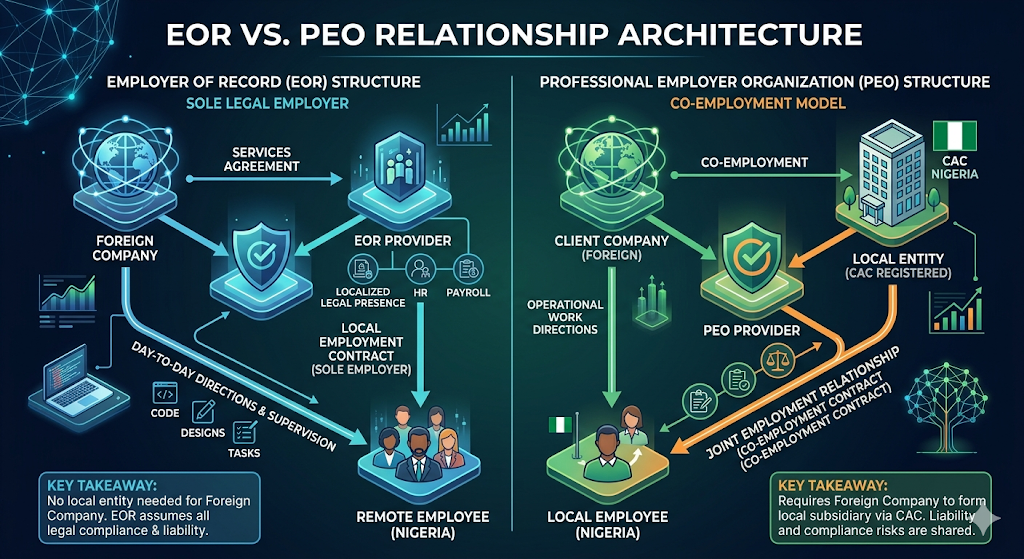
[EOR Model Architecture]

Your Company <─── (Day-to-Day Operational Management) ───► Employee
       │                                                         ▲
       ▼                                                         │
EOR Provider ◄──────────── (100% Sole Legal Employer) ───────────┘

[PEO Model Architecture]

Your Company ◄─── (Co-Employment Liability Framework) ───► PEO Provider
       │                                                         │
       └─────────── (Shared / Joint Legal Employers) ────────────┴──► Employee
What is an Employer of Record (EOR) in Nigeria?
An Employer of Record (EOR) is a third-party organization that becomes the sole legal employer of your staff in Nigeria. Under this arrangement, the EOR provider assumes 100% of the employment liability, compliance risks, and administrative burdens.
The EOR hires the worker through a locally compliant employment contract that satisfies the strict mandates of the Labour Act (Cap L1, LFN 2004). They handle local onboarding, run monthly payroll in Nigerian Naira (NGN), calculate and withhold progressive Personal Income Tax (PIT), and remit all mandatory social security contributions to the appropriate government bureaus.
The beauty of the EOR model lies in its operational division: while the EOR serves as the legal employer on paper, your company retains 100% day-to-day operational control. You manage the employee’s tasks, workflows, performance reviews, and daily deliverables exactly as you would with any internal team member.
What is a Professional Employer Organization (PEO) in Nigeria?
A Professional Employer Organization (PEO) operates on a co-employment model. When you partner with a PEO, a joint legal relationship is established: your business and the PEO share the responsibilities and liabilities of employment.
The PEO acts as your administrative HR department, managing heavy-lifting tasks like payroll processing, benefits administration, and tax filings under its own corporate umbrella. However, because it is a co-employment structure, your company remains a legal employer of record.
This shared liability creates a distinct operational prerequisite: to utilize PEO services in Nigeria, your foreign business must already have an established, registered legal entity within the country. The PEO simply hooks into your existing local corporate infrastructure to streamline HR operations.
2. Bypassing Entity Registration: The Operational Reality of Employer of Record (EOR) vs. Professional Employer Organization (PEO) in Nigeria
The fundamental difference between these two systems shapes your initial expansion timeline, upfront capital expenditures, and corporate compliance strategy. It boils down to a simple question: Are you ready to establish a permanent corporate subsidiary in Nigeria?
The Reality of Setting Up a Nigerian Subsidiary
If you choose the PEO route, your expansion journey must begin at the Corporate Affairs Commission (CAC), the government body responsible for regulating the formation and management of companies in Nigeria.
Registering a foreign-owned subsidiary through the CAC is a resource-heavy, bureaucratic process. Under current regulations, it requires:
- Substantial minimum share capital requirements (often set higher for foreign-owned enterprises).
- Appointing local company directors and corporate secretaries.
- Opening commercial local corporate bank accounts within Nigeria.
- Registering with the Federal Inland Revenue Service (FIRS) and respective State Internal Revenue Services (such as the LIRS in Lagos).
- Securing physical, verifiable corporate office addresses.
This process typically takes between 2 to 4 months of bureaucratic processing and costs anywhere from $15,000 to $50,000 in legal fees, structural setup costs, and ongoing administrative overhead.
How an EOR Provides a Turn-Key Legal Short-Cut
For businesses looking to avoid entity setup, an EOR serves as an immediate alternative. Because the EOR provider has already heavily invested in building its own compliant corporate infrastructure, registered local entities, and expert HR teams within Nigeria, you bypass the CAC entirely.
By utilizing localized EOR frameworks, your international business can identify a target candidate, execute a master service agreement with the EOR provider, and have that employee legally onboarded and working within 1 to 2 weeks. This unlocks unparalleled speed-to-market, allowing startups and enterprises alike to test product-market fit or scale up remote engineering teams without long-term legal entanglements.
3. Comparing Legal Liabilities: Employer of Record (EOR) vs. Professional Employer Organization (PEO) in Nigeria
Understanding the risk allocation between an Employer of Record (EOR) vs. Professional Employer Organization (PEO) in Nigeria requires a deep dive into the regulatory enforcement landscape. The Nigerian government, via its state and federal tax authorities, has drastically stepped up compliance monitoring to maximize non-oil revenue collection.
1. The Dynamic Minimum Wage Landscape
Following the historic passage of the National Minimum Wage Act, the federal statutory minimum wage is benchmarked at ₦70,000 per month (gross) for full-time employment. However, compliance is highly regionalized.
As of 2026, dynamic regional adjustments have created a highly fragmented wage landscape across different states:
- Lagos State: Has scaled its minimum wage baseline up to ₦85,000 per month.
- Imo State: Leads the baseline chart with an approved minimum wage of ₦104,000 per month for public sectors, driving up private sector compensation expectations.
- Rivers State: Disburses a baseline of ₦85,000 per month.
Employers must ensure that an employee’s fixed basic pay meets these hyper-localized thresholds. Variable performance bonuses, one-off allowances, or benefits-in-kind cannot be used to artificially “fill the gap” to hit the statutory floor.

2. The Progressive PAYE Tax Bracket Redesign
The tax framework utilizes restructurings for the Pay-As-You-Earn (PAYE) Personal Income Tax (PIT) brackets. Payroll systems must apply these progressive bands after factoring in updated Consolidated Relief Allowances (CRA):
| Annual Taxable Income Band (NGN) | Tax Rate (%) |
| First ₦800,000 or less | 0% (Full Tax-Free Threshold Exemption) |
| ₦800,000.01 to ₦3,000,000 | 15% |
| ₦3,000,000.01 to ₦12,000,000 | 18% |
| ₦12,000,000.01 to ₦25,000,000 | 21% |
| Above ₦25,000,000 | 24% |
3. Progressive Rent and Accommodation Reliefs
- Rent Relief: Workers can claim a specialized tax exemption of 20% on their annual rent payments, capped at a maximum deduction of ₦500,000 per year, subject to proper state filing and declaration.
- Accommodation Benefit-in-Kind (BIK): When an employer provides housing benefits, the taxable benefit value is strictly capped at a maximum of 20% of the employee’s annual gross employment income.
4. High-Value Severance Tax Exemptions
To shield transitioning workers, compensation for loss of employment (severance pay) is granted a tax-exempt status up to ₦50 million. Any severance amount paid beyond this ₦50 million ceiling is pulled into the progressive PAYE tax net.
5. Increased Judicial Enforcement
The National Industrial Court of Nigeria (NICN) has drastically increased its scrutiny of worker exploitation, improper termination, and employee misclassification. If an international business treats a local worker as an independent contractor when their daily operations mirror a full-time employment relationship, the NICN heavily penalizes the firm, forcing back-payments of taxes, pensions, and statutory benefits.
The Liability Risk Factor: Under an EOR model, if a payroll settings toggle is misconfigured or a tax deadline is missed, the EOR provider suffers the penalties and legal heat. Under a PEO co-employment model, your business shares that legal liability, exposing your CAC-registered entity directly to the FIRS, state tax boards, and the National Industrial Court.
4. Statutory Payroll Compliance and Financial Math in Nigeria
Executing a compliant payroll process via a global payroll provider Nigeria requires managing separate payments to multiple distinct government bodies. For foreign companies, calculating these gross-to-net deductions accurately each month is an operational headache.
Whether managed entirely by an EOR or co-managed with a PEO, your workforce strategy must seamlessly account for these core statutory deductions:
The Pension Reform Act 2014
For any employer with 15 or more staff members, enrollment in the national pension scheme is strictly mandatory. The contributions are calculated as a percentage of the employee’s monthly emoluments (which includes basic salary, housing, and transport allowances):
- Employer Contribution: 10%
- Employee Deduction: 8%
- Total Pension Flow: 18% remitted to the employee’s chosen Pension Fund Administrator (PFA) within 7 days of salary payment.
- Group Life Insurance: Under this same act, employers must fund a comprehensive group life insurance policy valued at a minimum of three times the employee’s total annual compensation.
National Health Insurance Authority (NHIA) Act
For organizations employing 10 or more individuals, healthcare coverage is a statutory requirement.
- Employer Contribution: 10% of basic salary.
- Employee Deduction: 5% of basic salary.
- Coverage: This mandatory scheme covers primary medical care for the employee, their spouse, and up to four dependent children under the age of 18 through accredited Health Maintenance Organisations (HMOs).
Nigeria Social Insurance Trust Fund (NSITF)
Administered under the Employee Compensation Act, this is an employer-only contribution of 1% of total monthly payroll. It funds a centralized national safety net that provides financial compensation and rehabilitation for workers who suffer work-related injuries, occupational diseases, disabilities, or workplace fatalities.
Industrial Training Fund (ITF)
If your corporate operations scale to employ 5 or more workers, or if your local entity achieves an annual turnover of ₦50 million or more, you must contribute 1% of your entire annual payroll to the ITF to fund national vocational and technical training initiatives.
National Housing Fund (NHF)
Employees earning above the baseline must contribute 2.5% of their basic monthly salary to the Federal Mortgage Bank of Nigeria, which provides affordable housing loan access to Nigerian nationals.
[Gross Monthly Salary Components]
        │
        ├──► Deduct PAYE Tax (0% - 24% Progressive Band)
        ├──► Deduct Employee Pension (8% of Emoluments)
        ├──► Deduct Employee NHIA Health (5% of Basic)
        ├──► Deduct Employee NHF (2.5% of Basic)
        │
        ├──► Add Employer Pension (10% of Emoluments)
        ├──► Add Employer NHIA Health (10% of Basic)
        ├──► Add Employer NSITF (1% of Payroll)
        └──► Add Employer ITF (1% of Annual Payroll)
        │
[Net Pay Disbursed in NGN to Local Bank Account]
The Compliance Penalty Trap
Failing to track these dates and amounts triggers immediate financial penalties. For instance:
- Pension Defaults: Attracts a 2% monthly interest penalty on all unremitted amounts.
- NSITF Violations: Carries a baseline 10% penalty fee.
- PAYE Delays: Missing the 10th-of-the-month deadline can lead to audit penalties and potential criminal prosecution for tax evasion.
An EOR functions as a corporate firebreak. They track these calendars, execute precise gross-to-net calculations, and handle the localized filings, keeping your organization out of harm’s way.
5. Intellectual Property and Data Privacy (NDPA) Under Both Models
For fast-growing technology companies, international product teams, and creative agencies, expanding into a foreign territory poses two massive risks: Intellectual Property (IP) leakage and data privacy breaches.
The IP Trap in Cross-Border Hiring
Under standard Nigerian common law and the Labour Act, IP created by an independent contractor or an improperly structured employment layer can easily become legally ambiguous. If an employee creates proprietary software code or design while working for a foreign firm that lacks a local legal entity, claiming absolute ownership during subsequent venture capital audits or M&A due diligence can trigger legal gridlocks.
- How an EOR Solves This: Premium EOR providers use master corporate services agreements coupled with localized tripartite employment contracts. These agreements explicitly contain ironclad, automatic IP assignment clauses recognized under Nigerian law. The moment your developer writes a line of code, the IP is legally transferred from the employee to the EOR, and automatically assigned directly to your parent enterprise.
- The PEO Approach: Since a PEO operates under a co-employment framework, they generally leave corporate IP protection strategies entirely up to you. Your legal team must independently draft and execute supplementary Non-Disclosure Agreements (NDAs) and IP assignment contracts to protect your core business assets.
Data Privacy under NDPA
The regulatory landscape is heavily policed by the Nigeria Data Protection Act (NDPA). Any entity processing the personal data of Nigerian citizens must implement strict data privacy controls.
An EOR manages full compliance with data protection policies during onboarding, payroll, and benefits processing. This ensures your organization avoids the severe financial fines levied by the Nigeria Data Protection Commission (NDPC) for data mishandling.
6. Strategic Comparison Table: Employer of Record (EOR) vs. Professional Employer Organization (PEO) in Nigeria
To give your executive leadership team full clarity, let’s look at a head-to-head operational comparison of how these services function side-by-side in the Nigerian market.
| Feature / Aspect | Employer of Record (EOR) | Professional Employer Organization (PEO) |
| Local Entity Requirement | Not Required. You utilize the EOR’s established legal entities. | Mandatory. You must register a local subsidiary with the CAC. |
| Employment Structure | Sole Legal Employer. The EOR assumes 100% employer status. | Co-Employment. Shared legal relationship between you and the PEO. |
| Compliance & Legal Risk | Transferred entirely to the EOR provider. | Shared Risk. Your entity is exposed to local legal disputes. |
| Onboarding Speed | Extremely Fast (1 to 2 weeks). | Slow (2 to 4 months due to entity setup timelines). |
| Cost Structure | Predictable flat monthly fee per employee ($300 – $600). | Typically a percentage of gross payroll (2% to 12%). |
| Intellectual Property (IP) | Automated, ironclad IP assignment built into local contracts. | Left up to your company’s independent legal frameworks to secure. |
| Best Suited For | Testing markets, remote teams, rapid scaling, and small cohorts (1-20 staff). | Long-term market permanence with large local workforces (50+ staff). |
7. The Final Verdict: Choosing Between an Employer of Record (EOR) vs. Professional Employer Organization (PEO) in Nigeria
To choose between an Employer of Record (EOR) vs. Professional Employer Organization (PEO) in Nigeria for your international workforce expansion, evaluate your long-term operational goals against this clear decision matrix:
Scenario A: The Agile Tech Startup or Mid-Market Firm Testing the Waters
- Your Goal: You want to hire 2 software engineers and 1 product manager in Lagos immediately. You are unsure of what your long-term African corporate presence will look like over the next 24 months.
- The Verdict: Choose an Employer of Record (EOR). Bypassing the CAC saves you months of administrative delays and tens of thousands of dollars in subsidiary registration fees. You enjoy an all-inclusive, predictable flat monthly fee, speed-to-market, and zero local compliance risks.
Scenario B: The Enterprise Capitalized for Multi-Year Regional Permanence
- Your Goal: You are executing a major infrastructure expansion. You intend to set up local physical offices in Abuja and Lagos, hire a massive local workforce of 60+ individuals across factory operations, sales, and logistics, and want direct corporate bank accounts.
- The Verdict: Choose a Professional Employer Organization (PEO). At this large scale, the flat per-head fees of an EOR can become costly over time. It makes financial and strategic sense to invest upfront in registering a formal local subsidiary through the CAC. Partnering with a PEO allows you to outsource the immense administrative HR and payroll burdens of those 60+ workers while maintaining direct control through your registered entity.
Final Summary & On-Page SEO Best Practices
To ensure your corporate expansion team is fully prepared, let’s look at a quick final audit checklist:
- Audit Current Entity Status: Do you have a CAC certificate? If no, focus on EOR services to ensure immediate compliance.
- Verify Wage Floors: Ensure your compensation packages start well above the updated statutory ₦70,000 national minimum wage (or higher depending on state-level modifications like Lagos at ₦85,000).
- Implement Tax Reform Rules: Confirm your global payroll provider has updated their computation engines to reflect the progressive PAYE brackets and rent relief exemptions.
- Optimize for Mobile Access: Ensure your corporate onboarding workflows and employee portal interfaces are fully mobile-responsive, as a vast majority of the Nigerian workforce manages communication via mobile devices.
Conclusion
Expanding your workforce into Nigeria is a high-reward strategic move that opens the door to an exceptionally skilled, motivated pool of professional talent. However, long-term success requires structural compliance.
If you want immediate market entry, minimal upfront setup costs, and a total transfer of legal liability, partnering with a dedicated Employer of Record in Nigeria is your optimal path. If you are committed to a permanent local presence and are ready to anchor your business with a formal CAC corporate registration, then leveraging PEO services in Nigeria will give you the localized HR administrative leverage you need.
What has your experience been with cross-border hiring in Africa? Have you encountered challenges with local payroll or entity setup? Let us know your thoughts, questions, or experiences in the comments section below! If you found this strategic breakdown valuable, share it with your HR leadership team and global expansion directors.
Quick Answers: Frequently Asked Questions
Can I hire workers in Nigeria without setting up a local company?
Yes, but only if you use an Employer of Record (EOR). An EOR already has a legal setup in Nigeria, so they can hire your team under their name. If you use a PEO, you must register your own company with the Corporate Affairs Commission (CAC) first.
Who is the legal boss of the employee?
- With an EOR: The EOR provider is the sole legal employer on paper. They take on 100% of the legal risk.
- With a PEO: It is a co-employment setup. Both your company and the PEO share legal responsibilities and risks.
If I use an EOR, do I lose daily control over my team?
Not at all. The EOR only handles the boring back-office stuff—like payroll, taxes, and contracts. You still manage your team’s daily tasks, deadlines, work hours, and performance reviews exactly how you want.
What is the lowest salary I can legally pay in Nigeria?
As of 2026, the national minimum wage is ₦70,000 per month. However, certain areas have higher requirements. For example, if your worker is based in Lagos, the minimum baseline is ₦85,000 per month.
Who takes the blame if taxes or pensions are paid late?
- With an EOR: The EOR provider takes 100% of the blame and pays any government fines.
- With a PEO: Because you share legal employer status, your company faces the fines and legal audits directly from tax authorities like the FIRS.
Who owns the app code or design my worker creates?
- With an EOR: Your intellectual property (IP) is completely safe. The contract automatically passes all rights from the worker to the EOR, and straight to your company.
- With a PEO: You are responsible for protecting your own IP. You will need to have your workers sign separate legal contracts to secure your company secrets.
Scale Your Nigerian Team Risk-Free with GroConsult
Ready to skip the CAC bureaucracy and hire in Nigeria instantly?
Choosing between an EOR and a PEO is tough, but executing it flawlessly shouldn’t be. Whether you need a turn-key Employer of Record (EOR) to hire elite tech talent without a local entity or a robust PEO partner to run your existing Nigerian subsidiary’s payroll, GroConsult Management Consortium handles the heavy lifting.
- 100% Compliant Onboarding: Fully aligned with the latest 2026 dynamic minimum wage adjustments (including the ₦85,000 Lagos baseline).
- Flawless Payroll & Tax Engineering: Automated handling of local progressive PAYE bands, NHIA, and Pension Reform Act deductions.
- Ironclad Asset Protection: Automatic, bulletproof IP assignment clauses moving from local workers straight to your parent company.
Don’t let compliance red tape slow down your African expansion strategy. Talk to a GroConsult Expansion Expert Today and onboard your first Nigerian remote worker in less than 7 days.