
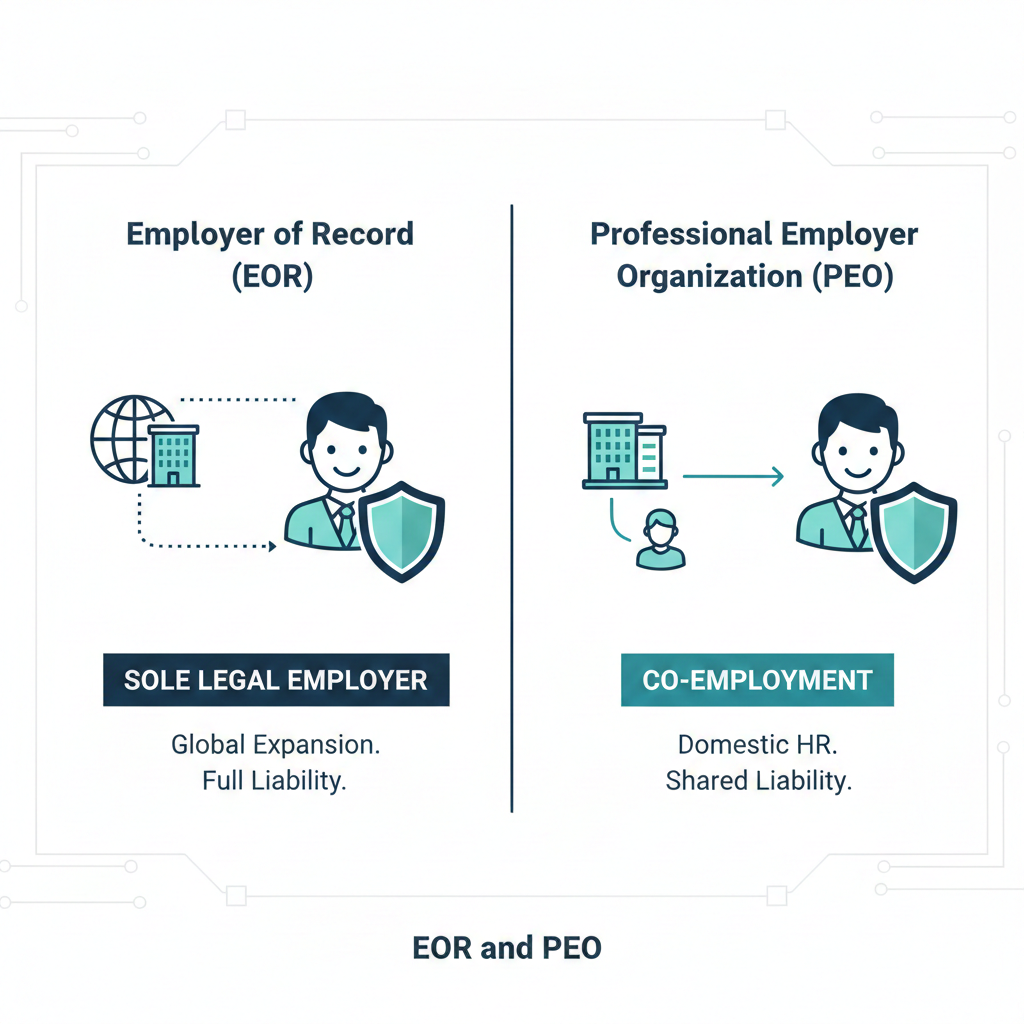
An Employer of Record (EOR) is the sole legal employer of your staff in a foreign country; no local entity is required. A Professional Employer Organisation (PEO) operates as a co-employer alongside your existing registered entity in-country. The key difference: EOR is for companies without a local presence; PEO is for those that already have one. For international market entry, EOR is almost always the right starting point.
EOR and PEO are acronyms for two distinct, yet often confused, models of Human Resources (HR) outsourcing used by companies, particularly when managing workforce expansion across different regions or international borders. Understanding the fundamental differences between an Employer of Record (EOR) and a Professional Employer Organization (PEO) is crucial for businesses seeking compliant, efficient, and flexible growth. This guide will clarify the core definitions, legal implications, and use cases for both the EOR and PEO models.
Defining the EOR and PEO
An Employer of Record (EOR) is a third-party service provider that legally employs a worker on behalf of a client company. In this arrangement, the EOR assumes the full legal responsibility and liability associated with formal employment. The worker signs an employment contract directly with the EOR, which ensures complete compliance with all local labor laws, taxation, and regulatory requirements in that specific jurisdiction.
A Professional Employer Organization (PEO) is an organization that partners with a client company to provide comprehensive HR support through a co-employment model.
Key Functions of the EOR Model:
- Sole Legal Employer: The EOR is the sole entity responsible for the legal aspects of employment, including drafting and managing compliant employment contracts, termination processes, and handling government filings.
- Global Expansion: The primary advantage of an EOR is that it allows a company to hire employees in a country or state where the company does not have a registered legal entity. This drastically reduces the time and cost typically associated with establishing foreign subsidiaries.
- Compliance & Risk: The EOR takes on all liability for payroll, statutory benefits, tax withholding, and labor law compliance, insulating the client company from complex foreign regulations.
- Operational Control: Crucially, while the EOR handles the administrative and legal burden, the client company retains full control over the worker’s day-to-day work, job duties, performance reviews, and management structure.
Understanding International Labor Regulations.
EOR vs. PEO: Summary of Differences
Read Also:
- Employer of Record Services: 5 Elite Ways to Scale in Ghana
- The Seamless Solution to Global Expansion: How Employer of Record (EOR) Services Empower International Growth in 2026
- Contractor Management Services in Ghana & West Africa: The Complete Guide
The EOR model is the gold standard for global companies looking to hire one or more employees quickly and compliantly without creating a permanent foreign establishment.
Defining the Professional Employer Organization (PEO)
In contrast to the EOR model, a Professional Employer Organization (PEO) operates under a co-employment structure. This means the client company and the PEO share employer responsibilities. The client company remains the primary legal employer (the worksite employer), responsible for day-to-day management and core business activities. The PEO, however, is designated as the “administrative employer.”
Key Functions of the PEO Model:
- Co-Employment Relationship: The client company maintains its legal entity and hires its employees directly. The PEO then provides administrative services under a co-employment agreement.
- Shared Liability: Legal and compliance responsibilities are shared. The client company remains ultimately responsible for major employment decisions, though the PEO assists with managing administrative compliance.
- Domestic Focus: PEOs are most commonly used by small to medium-sized businesses (SMBs) to outsource complex HR administration within a location where the client company is already legally registered.
- Benefits & Cost Savings: Because PEOs aggregate the employees of all their client companies, they can often offer small businesses access to higher-quality, more affordable group health insurance, retirement plans, and other benefits that the SMB could not secure on its own.
A PEO is essentially an outsourced, shared-service HR department, providing expertise in payroll, benefits, and general HR consulting.
EOR vs PEO: Comparison
| Aspect | Employer of Record (EOR) | Professional Employer Organization (PEO) |
| Legal Relationship | Sole Legal Employer (EOR hires worker) | Co-Employment (Client & PEO share status) |
| Required Entity | No Local Entity Required for the client. | Local Legal Entity Required for the client. |
| Liability & Risk | EOR assumes Full Liability. | Liability is shared between the client and the PEO. |
| Primary Use Case | Global expansion, hiring internationally, and testing new markets compliantly. | Domestic HR outsourcing, accessing better employee benefits, and reducing administrative load for existing companies. |
| Speed of Deployment | EOR is faster (no entity needed) | PEO depends on you having an existing entity setup |
| Best for company stage | Market entry / testing | Established companies scaling HR |
By using an EOR or a PEO to manage their human capital, companies can ensure they meet their administrative goals. Choosing between the two depends entirely on a company’s existing legal presence, the location of its employees, and its tolerance for employment liability. For truly borderless expansion, the EOR model is the clear choice. For streamlining HR operations domestically, the PEO is an invaluable partner.
EOR vs PEO in Africa: What Foreign Companies Need to Know
The global EOR vs PEO framework is useful as a starting point, but for companies expanding into African markets, the choice between the two models is rarely a genuine debate. In practice, EOR is almost always the right structure for foreign companies entering Africa, and understanding why requires a clear look at how African market entry actually works on the ground.
Why PEO Rarely Applies at the African Market Entry Stage
A Professional Employer Organisation requires your company to already have a registered legal entity in the target country. In the UK, US, or Australia, where companies already operate domestically, this co-employment model makes sense: you have the entity, you need HR and payroll support, and a PEO provides it as an outsourced function.
In Africa, the picture is different. Most foreign companies entering Ghana, Côte d’Ivoire, Togo, Nigeria, or Liberia for the first time do not have a registered local subsidiary. They are testing the market, deploying a small team, or launching a project. Registering a local entity, through the Registrar General’s Department in Ghana, the CEPICI in Côte d’Ivoire, or the Corporate Affairs Commission in Nigeria, takes 6–12 weeks, requires sustained local legal and accounting support, and creates an ongoing compliance infrastructure that many companies are not ready to manage from abroad.
The PEO model, which depends on that entity existing, is simply not available to them. EOR removes that dependency entirely.
What EOR Makes Possible in African Markets
Across GroConsult’s active markets in Africa, EOR enables foreign companies to:
Hire compliantly from day one without waiting for entity registration to complete. For companies with a project start date, a client commitment, or a competitive hiring window, this matters enormously.
Meet local employer obligations without a local HR function: payroll tax filings with the Ghana Revenue Authority, SSNIT contributions in Ghana, CNSS filings in Côte d’Ivoire and Togo, and employment contracts compliant with each country’s Labour Act or Labour Code are all managed by the EOR.
Sponsor work permits for expatriate staff in most African markets. Work permit sponsorship requires a locally registered employer. An EOR with an established local entity fulfils this requirement on behalf of the foreign company, enabling the deployment of expatriate hires without the foreign company needing its own entity.
Operate across multiple African countries simultaneously through a single EOR partner rather than managing separate entity registrations, compliance obligations, and payroll systems in each country independently.
When Does PEO Become Relevant in Africa?
PEO becomes the appropriate model once a foreign company has established a registered entity in an African country and wants to outsource the HR and payroll management function to a specialist provider. This is typically the right structure for:
- Companies that have passed the market testing phase and committed to a permanent African presence
- Large multinationals with existing African subsidiaries seeking to standardise HR operations across multiple countries
- Companies that have transitioned from EOR to a registered entity and want to retain outsourced payroll management
In these scenarios, GroConsult provides co-employment and payroll management services in our key markets, functioning as a PEO partner once your entity is in place.
The Africa EOR vs PEO Decision: A Simple Framework
| Question | If Yes → |
|---|---|
| Do you have a registered legal entity in the African country? | PEO may be appropriate |
| Are you entering an African market for the first time? | EOR is the right structure |
| Do you need to hire within weeks, not months? | EOR is the right structure |
| Are you deploying expatriate staff who need work permit sponsorship? | EOR is the right structure |
| Do you have an established African subsidiary and want outsourced HR? | PEO may be appropriate |
GroConsult’s EOR and PEO Coverage in Africa
GroConsult provides both EOR and PEO services across our active African markets, including Ghana, Côte d’Ivoire, Togo and beyond. Whether you are entering a new African market and need an EOR to get your first hire compliant from day one, or you have an established African entity and want expert payroll management support, our team can structure the right solution for your stage of growth.
Book a free consultation with our Africa Desk to discuss which model is right for your specific market and structure.
Frequently Asked Questions: EOR vs PEO
What is the difference between EOR and PEO?
An Employer of Record (EOR) is the sole legal employer of your staff in a target country, taking on full statutory responsibility for employment contracts, payroll tax, social security contributions, and labour law compliance on your behalf. Your company does not need a registered local entity. A Professional Employer Organisation (PEO) operates as a co-employer alongside your existing registered entity, sharing the employment relationship and managing HR and payroll functions jointly with you. The fundamental difference is this: EOR removes the need for a local entity; PEO requires one to already exist. For companies entering a new country for the first time, EOR is almost always the appropriate model.
When should I use an EOR instead of a PEO?
Use an EOR when you are entering a new market without a registered local entity, deploying staff quickly without a 6–12 week entity registration wait, hiring in a country where setting up a subsidiary is complex or commercially premature, or sponsoring work permits for expatriate staff who need a locally registered employer. Use a PEO when your company already has a registered entity in the target country and you want to outsource payroll processing, statutory filings, and HR administration to a specialist provider. In African markets specifically, EOR is the dominant model for foreign companies at the market entry stage because most do not yet have local entities in place.
Is EOR better than PEO for international expansion?
For most companies at the international expansion stage, particularly those entering markets in Africa, Southeast Asia, or Latin America for the first time, EOR is the more practical and faster model. It eliminates the entity registration requirement, reduces compliance risk in unfamiliar regulatory environments, and allows companies to hire, test, and scale in a new market without the overhead of a permanent local structure. PEO becomes the better model once a company has committed to a permanent local presence and wants to retain outsourced HR management alongside its registered entity. The two models are not competitors, they serve different stages of the same expansion journey.
Do I need a local entity for a PEO?
Yes. A PEO operates as a co-employer which means your company must already hold a registered legal entity in the country where the PEO will operate. Without a local entity, there is no employment relationship for the PEO to co-manage. This is the critical distinction between PEO and EOR: an EOR becomes the legal employer in full, removing the entity requirement entirely, while a PEO shares the employer role with a company that already has local legal standing. In markets like Ghana, Côte d’Ivoire, and Togo where entity registration can take 6–12 weeks, the absence of a local entity makes EOR the only compliant route for a foreign company’s first hires.