Setting up a subsidiary in the Ivory Coast is no longer just a “frontier” ambition; it has become a strategic imperative for those looking to dominate the West African market. As the world’s leading cocoa producer and a top cashew exporter, Côte d’Ivoire (Ivory Coast) offers a robust, resource-rich gateway.
Setting up a subsidiary in the Ivory Coast involves choosing a legal structure, Société à Responsabilité Limitée (SARL) or Société Anonyme (SA), translating and notarizing corporate documents into French, depositing share capital in a local bank, appointing a resident director, and securing a physical office address. Registration through CEPICI typically takes 3–5 weeks. The standard corporate tax rate is 25%, and 100% foreign ownership is permitted under OHADA law.
Why Setting Up a Subsidiary in the Ivory Coast is the Right Move for 2026
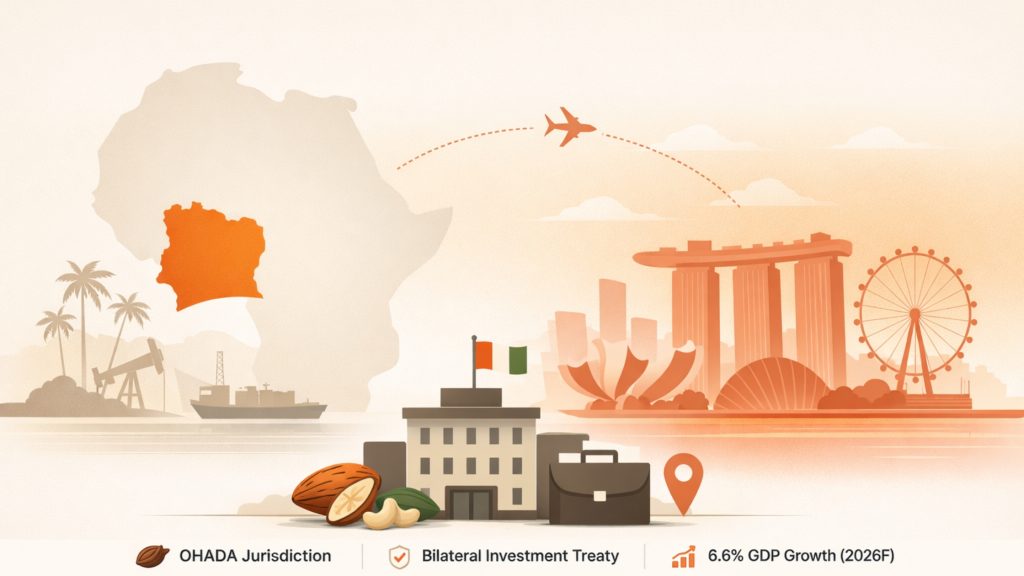
The economic synergy between the “Little Red Dot” and the “Elephant of West Africa” is reaching an all-time high. According to the Ministry of Trade and Industry (MTI), bilateral trade hit $185.8 million in 2024, with Singaporean direct investment stock in the country exceeding $730 million SGD.
With an IMF-projected GDP growth rate of 6.6% for 2026, the Ivory Coast is outpacing most of its regional peers. The government’s “2030 Vision” emphasizes local value-addition, moving from raw exports to high-tech processing. This creates a massive opening for Singaporean firms specializing in logistics, food technology, and sustainable infrastructure.
The OHADA Advantage
When setting up a subsidiary in the Ivory Coast, you are entering the OHADA (Organization for the Harmonization of Business Law in Africa) zone. This is a unified legal system shared by 17 African nations. For a Singaporean firm, this means that once you master the legal requirements in Abidjan, the same rules apply if you expand into Senegal, Cameroon, or Gabon. It provides a level of legal predictability that is rare in emerging markets.
5 Critical Requirements for Setting Up a Subsidiary in the Ivory Coast
Navigating the administrative landscape requires precision. The Ivorian government has streamlined the process through the CEPICI (Centre for the Promotion of Investments), but Singaporean firms must still adhere to specific OHADA mandates.
Step 1: Choose your legal structure (SARL or SA)
The first step in setting up a subsidiary in the Ivory Coast is selecting your corporate vehicle. Most Singaporean multinationals opt for one of two structures:
- SARL (Société à Responsabilité Limitée): Similar to a Private Limited (Pte Ltd) company. It requires a minimum capital of 1,000,000 XOF (~$1,620 USD). It is the most common choice for SMEs.
- SA (Société Anonyme): Equivalent to a Public Limited Company. This is required for large-scale industrial projects or firms intending to list on the regional stock exchange (BRVM). The minimum capital is 10,000,000 XOF (~$16,200 USD).
| Feature | SARL | SA |
|---|---|---|
| Equivalent To | Private Limited (Pte Ltd) | Public Limited Company |
| Minimum Capital | 1,000,000 XOF (~$1,620 USD) | 10,000,000 XOF (~$16,200 USD) |
| Best For | SMEs, startups, market entry | Large-scale industrial or listed companies |
| Shareholders | 1–50 | Minimum 3 |
| Stock Exchange Listing | No | Yes (BRVM eligible) |
Step 2: Translate and notarize all documents into French
Ivory Coast is a Francophone jurisdiction operating under French civil law. All foreign corporate documents, including your Certificate of Incorporation, Board Resolutions, Articles of Association, and shareholder identification, must be translated into French by a certified translator before they will be accepted by the CEPICI.
Beyond translation, each document must go through a two-step legalization process:
- Notarization in your home country, authenticating the document’s origin and the identity of the signatories
- Legalization by the Ivorian Embassy (or consulate) in your home country, or via an Apostille if your country is a signatory to the Hague Apostille Convention
Companies from non-Apostille countries should budget additional time for full consular legalization, which can add 1–2 weeks to the preparation phase. Regardless of origin, engaging a bilingual legal professional or a local business setup specialist in Abidjan early in the process is strongly recommended; errors in translated documents are one of the most common causes of CEPICI registration delays.
Step 3: Deposit share capital in a local Ivorian bank
Before you can finalize the registration, you must deposit your share capital into a local Ivorian bank account or with a recognized notary. The bank will issue a Capital Deposit Certificate, which is a mandatory filing requirement. Foreign firms often find that while the registration is fast, opening the initial “capital deposit account” can take 5-10 business days due to rigorous KYC (Know Your Customer) protocols.
Step 4: Appoint a resident director (Gérant)
While the Ivorian law allows 100% foreign ownership, setting up a subsidiary in the Ivory Coast requires the appointment of at least one resident Director (Gérant). This individual does not have to be an Ivorian national, but they must have a valid residence permit (Titre de Séjour) if they are living in the country. Many foreign firms appoint a local “Nominee Director” during the transition phase to expedite paperwork.
Step 5: Secure a physical registered office in the Ivory Coast
You cannot register a company with a P.O. Box. You must provide a formal lease agreement for a physical office in the Ivory Coast. For many foreign startups, using a “Business Center” or “Virtual Office” in Abidjan’s Plateau district is a cost-effective way to meet this requirement in the early stages of expansion.
Post-Registration: Compliance, Tax, and Labour Laws
Successfully setting up a subsidiary in the Ivory Coast is only half the battle. Ongoing compliance is where many foreign firms stumble.
Tax Registration (DGI)
Once CEPICI issues your RCCM (Commercial Registry Number) and IDU (Unique Identifier Number), you must register with the Direction Générale des Impôts (DGI). Ivory Coast operates a territorial tax system. The standard corporate income tax rate is 25%, but many firms in the manufacturing or energy sectors qualify for tax holidays under the 2018 Investment Code.
Social Security (CNPS)
Every subsidiary must register with the Caisse Nationale de Prévoyance Sociale (CNPS). As an employer, you are responsible for contributing approximately 12-14% of the employee’s gross salary toward Social Security, while the employee contributes 6.3%.
Labour Compliance and Work Permits
If your parent company plans to send staff to Abidjan, they must obtain a Work Permit (Contrat de Travail pour Étranger). This requires proving that the skill set cannot be readily found in the local Ivorian labour market, a requirement that is usually waived for C-level executives and specialized engineers.
How Employer of Record Services Help Businesses in the Ivory Coast
Market Evidence: What Global Companies Have Achieved in the Ivory Coast
The roadmap for setting up a subsidiary in the Ivory Coast has already been paved by Singaporean pioneers.
- JB Cocoa: In 2024, Singapore-listed JB Foods commissioned a $63 million cocoa processing plant in Abidjan, highlighting the massive scale of investment possible.
- Royal Nuts & Valency International: These firms have capitalized on government incentives for “local processing,” setting up state-of-the-art factories that employ thousands of Ivorians.
These examples prove that efficiency and long-term planning work exceptionally well within the Ivorian growth framework.
Conclusion: Take the Lead in West Africa
Setting up a subsidiary in the Ivory Coast is a bold but calculated move for the modern Singaporean enterprise. The combination of the OHADA legal framework, the 2025 Singapore-Côte d’Ivoire BIT, and a booming local economy creates a “de-risked” environment for high-growth expansion.
Don’t navigate this journey alone. Whether you need assistance with global expansion services or local tax structuring, the right partnership is the key to your success in Abidjan.
Ready to start your expansion? Contact our West Africa Desk today to begin the process of setting up a subsidiary in the Ivory Coast with confidence.
Related read: 5 Challenges of Entering a New Market
FAQ: Setting Up a Subsidiary in the Ivory Coast
Can a foreign firm own 100% of an Ivorian subsidiary?
Yes. Under OHADA law and the 2018 Investment Code, foreign investors can own 100% of the shares in most sectors, including manufacturing, services, and technology.
How long does the registration process take?
Officially, the CEPICI “One-Stop Shop” can register a company in 48 hours. However, when you factor in document translation, notarization in Singapore, and capital deposit, the end-to-end process for setting up a subsidiary in the Ivory Coast typically takes 3 to 5 weeks.
What is the minimum capital for a manufacturing subsidiary?
For a standard SARL, it is 1,000,000 XOF (~$1,620 USD). However, if you are applying for incentives under the Investment Code (which requires a minimum investment of 200 million XOF), your startup capital will likely need to be higher to satisfy project finance requirements.
What is the difference between a subsidiary and a branch office in the Ivory Coast?
A subsidiary is an independent legal entity, typically registered as a SARL or SA, that is legally separate from its foreign parent company. It is taxed under Ivorian law at 25% and can enter into contracts, own assets, and hire staff in its own name. A branch office, by contrast, is a direct extension of the parent company with no separate legal identity. The parent bears full legal liability for the branch’s activities, and branch profits are taxed at 30%. For most foreign companies entering the Ivorian market for the long term, a subsidiary offers greater operational flexibility and lower tax exposure.
What language are business documents filed in the Ivory Coast?
All official business documents in the Ivory Coast must be filed in French. This includes your Articles of Association, Board Resolutions, shareholder agreements, and any correspondence with the CEPICI, DGI, or CNPS. Foreign companies must have all incorporation documents translated into French by a certified translator and legalized before submission. Engaging a bilingual legal or business setup partner in Abidjan is strongly advised to avoid delays caused by translation errors or non-compliant formatting.
Does the Ivory Coast have a double taxation treaty?
Yes. Ivory Coast has signed double taxation agreements (DTAs) with several countries, including France, Morocco, Tunisia, and WAEMU member states. These treaties help prevent the same income from being taxed in both Ivory Coast and the investor’s home country. Additionally, the 2025 Singapore-Côte d’Ivoire Bilateral Investment Treaty (BIT) provides Singaporean investors with specific protections around profit repatriation and non-discriminatory treatment, though it is distinct from a full DTA. Companies from countries without an existing DTA should seek local tax counsel to structure their Ivorian operations efficiently.
What is CEPICI?
CEPICI stands for Centre de Promotion des Investissements en Côte d’Ivoire (Centre for the Promotion of Investments in Ivory Coast). It is the government’s one-stop shop for company registration and investment facilitation. Through CEPICI, foreign investors can complete the majority of their registration formalities, including commercial registry filing, tax identification, and social security registration, in a single location. Officially, CEPICI can register a company within 48 hours, though the full end-to-end process, including document preparation abroad, typically takes 3–5 weeks.
How much does it cost to set up a subsidiary in the Ivory Coast?
The cost of setting up a subsidiary in the Ivory Coast varies depending on your chosen legal structure and the complexity of your operations. As a general guide:
- Minimum share capital: 1,000,000 XOF (~$1,620 USD) for a SARL; 10,000,000 XOF (~$16,200 USD) for an SA
- Notary and registration fees: typically 150,000–400,000 XOF, depending on capital size
- Document translation and legalization: varies by country of origin, typically $500–$1,500 USD
- Virtual or physical office setup: from 50,000 XOF/month for a business center address in Abidjan’s Plateau district
Additional costs may include legal advisory fees, nominee director fees, and bank account setup charges. GroConsult provides a transparent cost breakdown. Book a call with our West Africa Desk to get a figure tailored to your specific structure and sector.